Why Do Aluminium Profiles Bend? How Can It Be Prevented?
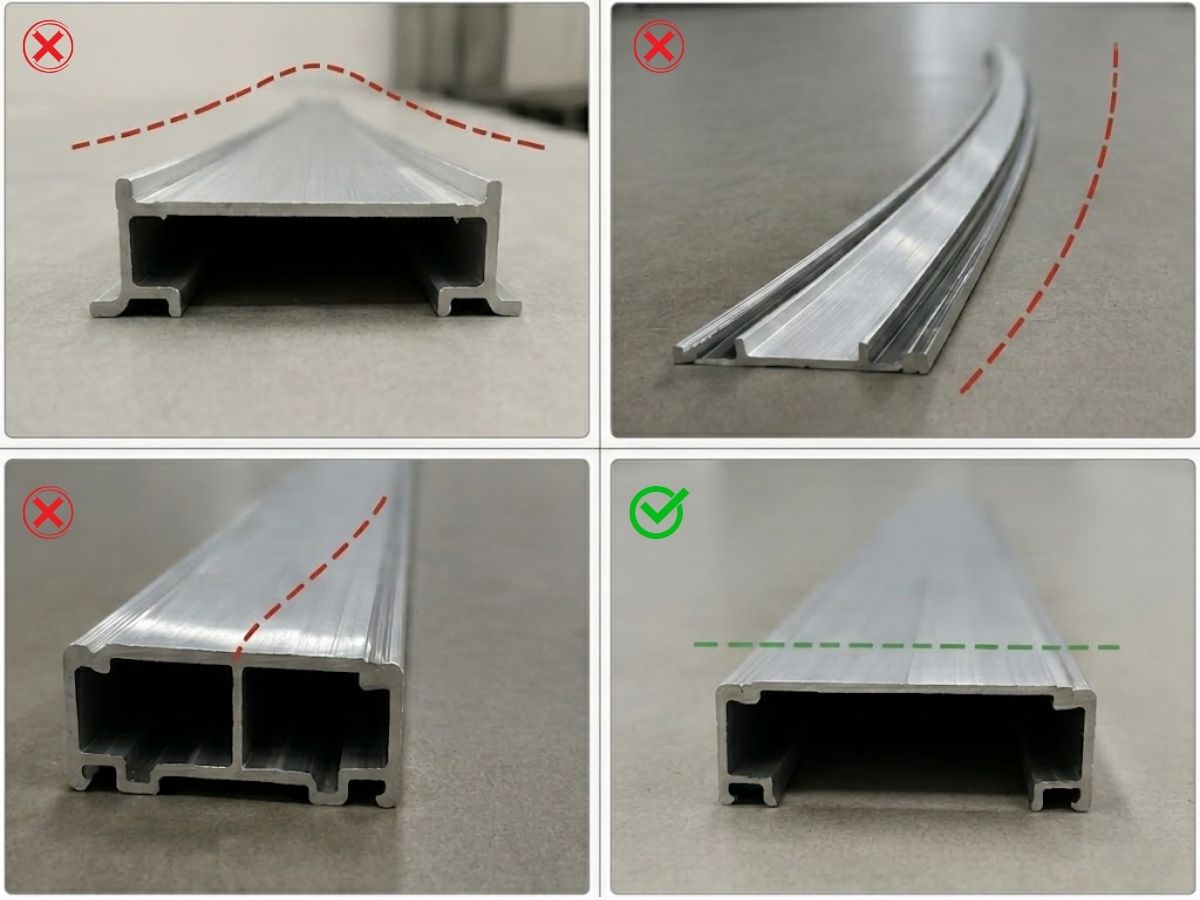
Aluminium profiles are widely used in construction, industrial, and architectural applications due to their lightweight nature and high strength. However, certain technical issues during production and processing can lead to unwanted deformation such as bending (warp or bowing). This not only affects visual quality but also directly impacts installation performance.
So, why does profile bending occur, and how can it be controlled?
1. Improper Cooling Process
One of the most common causes of profile bending is uneven cooling after extrusion. When different sections of the profile cool at different rates, internal stresses are formed.
These stresses can gradually pull the material in one direction, causing bending. Especially in large cross-section profiles, controlled and uniform cooling is a critical parameter.
2. Die Design and Flow Imbalance
If material flow is not properly balanced during die design, uneven density distribution can occur within the profile cross-section. This increases the risk of deformation after extrusion.
Well-engineered dies ensure uniform material flow across the entire section, minimizing this risk.
3. Poor Alloy or Billet Quality
Raw material quality is one of the most critical factors affecting profile stability. Non-homogeneous or low-quality billets can create structural inconsistencies during production.
Therefore, raw material control is a key step in the entire process.
4. Incorrect Stretching Process
The stretching process applied after extrusion is essential for straightening profiles. However, if applied incorrectly, it may either fail to correct deformation or introduce new internal stresses.
As a result, the profile may show bending again over time.
5. Heat Treatment and Aging Defects
The aging process, which stabilizes the mechanical properties of aluminium profiles, requires precise control of temperature and time.
Incorrect parameters may prevent stress relief and cause the profile to lose its shape stability over time.
How Can Profile Bending Be Prevented?
Preventing this issue requires a holistic approach across the entire production chain:
- Cooling must be controlled uniformly
- Die design should be optimized using flow simulations
- High and consistent quality raw materials should be used
- Stretching must be applied according to profile structure
- Heat treatment parameters must be precisely controlled
Profile Bending – Causes and Preventive Measures
1. Causes
| No | Problem | Description |
|---|---|---|
| 1 | Improper cooling process | Uneven cooling causes internal stresses leading to bending |
| 2 | Die and flow imbalance | Uneven material flow across the section causes deformation |
| 3 | Poor alloy / billet quality | Non-homogeneous structure reduces profile stability |
| 4 | Incorrect stretching process | Too little or excessive stretching leaves internal stress |
| 5 | Heat treatment and aging defects | Incorrect temperature/time affects profile shape stability |
2. Preventive Methods
| No | Solution | Description |
|---|---|---|
| 1 | Controlled cooling | Reduces internal stress through uniform cooling |
| 2 | Optimized die design | Ensures balanced material flow using simulation-based design |
| 3 | High-quality raw material | Consistent chemical composition reduces deformation risk |
| 4 | Correct stretching ratio | Stretching is applied according to profile geometry |
| 5 | Precise heat treatment control | Stable structure achieved through optimized temperature and timing |
Conclusion
Profile bending is not caused by a single error but by the accumulation of small imbalances in the production process. Therefore, the solution requires a holistic manufacturing approach and continuous process control.
Producing aluminium billets in-house enables control at the very first stage of the quality chain. This ensures greater stability and predictability throughout the entire production process, starting from raw material input.
Ultimately, the goal is not only to produce profiles, but to deliver products with high dimensional accuracy, long service life, and reliable performance.