One of the most important factors that determines quality in the aluminum extrusion industry is tolerance. Especially in architectural systems, automotive components, industrial equipment, and precision engineering applications, even the smallest dimensional deviations in aluminum profiles can lead to serious consequences.
Even a variation of a fraction of a millimeter in a profile can cause assembly problems, performance losses, and additional costs. For this reason, tolerance is not just a technical detail; it is a critical factor that directly affects product quality, safety, and service life.
What Is Tolerance?
In aluminum extrusion, tolerance refers to the allowable deviation range from the nominal dimensions of the produced profile.
For example, a profile dimension may be specified as 50 mm in a technical drawing. If the production tolerance is ±0.15 mm, the acceptable dimensional range for the product is between 49.85 mm and 50.15 mm.
In practice, producing with absolutely zero deviation is impossible. This is because many variables influence the production process, including temperature, alloy composition, extrusion pressure, die design, and cooling conditions.
What matters is ensuring that these deviations remain within the limits allowed by international standards and customer expectations.
Why Is Tolerance So Important?
1. Assembly Compatibility
Extrusion profiles are generally designed to work together with other components. This is especially critical in applications such as:
- facade systems,
- door and window profiles,
- automotive parts,
- industrial machinery systems.
All components must fit together precisely.
A profile that falls outside the tolerance range may cause gaps during assembly or prevent parts from fitting properly. This leads to additional labor, production delays, and increased costs.
2. Mechanical Strength
Even small changes in profile geometry can affect load-bearing performance.
Especially in structural applications, incorrect dimensions may lead to:
- reduced strength,
- deformation,
- loosening,
- long-term system failures.
For this reason, tolerance control is not only important for aesthetics but also for operational safety.
Factors Affecting Tolerance in Aluminum Extrusion
There are many technical factors that influence tolerance during the extrusion process.
Die Design
The more precisely the die is manufactured, the more stable the profile dimensions will be. Die quality is one of the foundations of tolerance success.
Alloy Composition
Not all alloys flow in the same way. The flow behavior of aluminum directly affects profile dimensions during extrusion.
Press Parameters
If extrusion speed, press pressure, and temperature balance are not properly controlled, dimensional deviations may occur.
Cooling Process
Uneven cooling may cause issues such as bending or twisting in the profile. Therefore, controlled cooling is extremely important.
Post-Production Processes Are Also Critical
Tolerance is not determined only on the extrusion press line. Post-production operations can also affect dimensional precision.
For example:
- stretching processes,
- cutting accuracy,
- surface treatments
may alter the final dimensions of the profile.
Therefore, high-quality extrusion production requires precise control of the entire manufacturing process.
The Role of International Standards
In the aluminum extrusion industry, tolerance values are defined by international standards. In Europe, the EN 755 standard is one of the main references for profile dimensional tolerances.
These standards help:
- establish common quality expectations between manufacturers and customers,
- ensure consistent production quality,
- prevent technical disputes.
In some special projects, much tighter tolerances than standard values may be required. In such cases, the manufacturer’s technical infrastructure and process control capabilities become critically important.
The Importance of Modern Measurement Technologies
Today, advanced quality control systems are widely used in modern extrusion facilities.
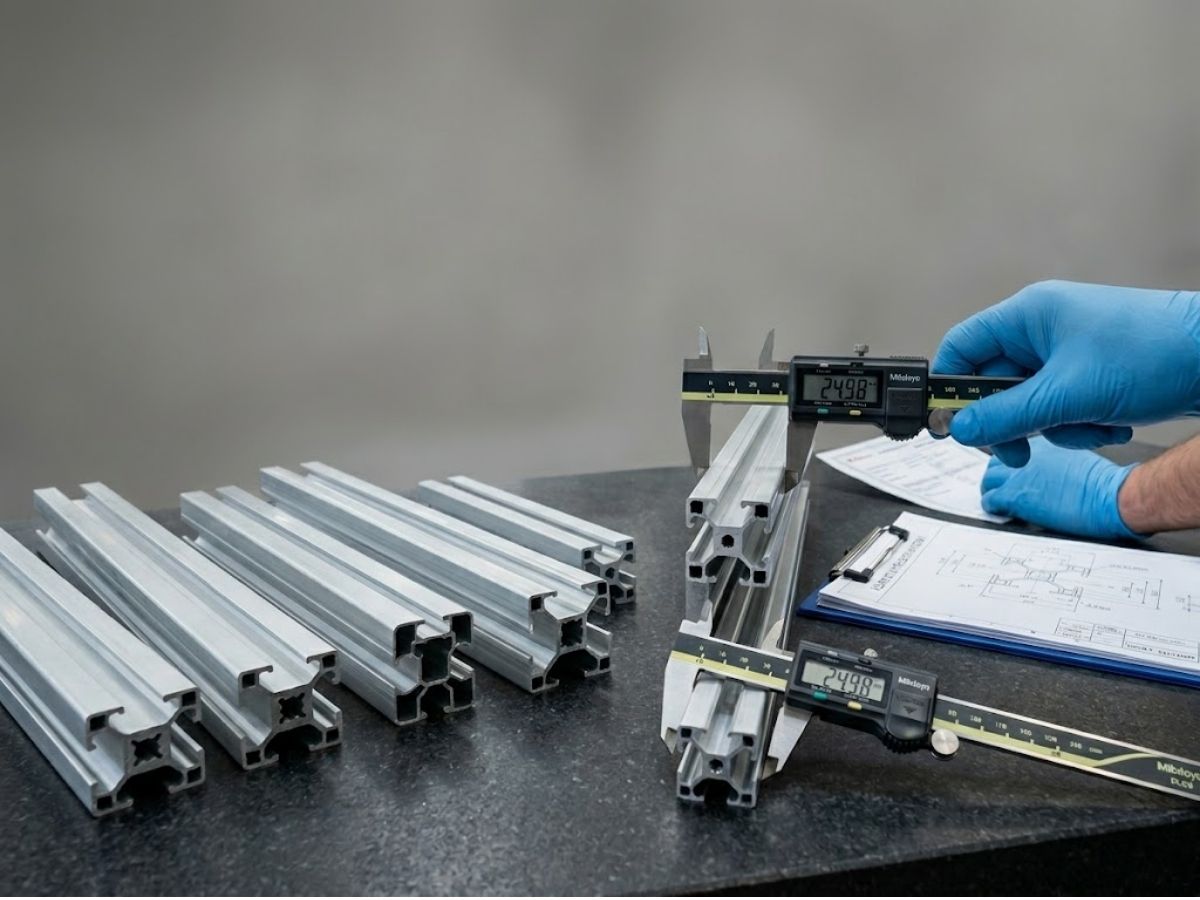
Thanks to digital measuring devices, optical inspection systems, and precision quality equipment, profiles can be continuously monitored during production. This allows potential deviations to be detected at an early stage and helps maintain quality consistency in mass production.
Conclusion
Tolerance in aluminum extrusion is one of the cornerstones of high-quality manufacturing. Precise tolerance control means:
- smoother assembly,
- higher performance,
- lower scrap rates,
- longer-lasting products.
For this reason, strong technical infrastructure, proper process management, and precise quality control systems are essential components of successful aluminum extrusion production.