What Is Homogenization? Why It Is Critical in Aluminium Billet Production
In the aluminium extrusion industry, billet production is one of the most important stages that determines the quality of the final product. However, producing a high-quality aluminium profile does not depend solely on the correct alloy composition during casting. The homogenization process applied after casting directly influences the internal structure of the billet and has a significant impact on extrusion behavior and final product quality.
Especially in industrial profiles, architectural systems, automotive components, and applications requiring tight tolerances, the quality of homogenization is a key factor in production performance. Therefore, the question “what is homogenization in aluminium billet?” is among the most frequently searched technical topics in the industry.
In this article, we explain in detail what homogenization in aluminium billets is, why it is applied, how it affects production processes, and why it is essential for high-quality extrusion.
What Is Homogenization?
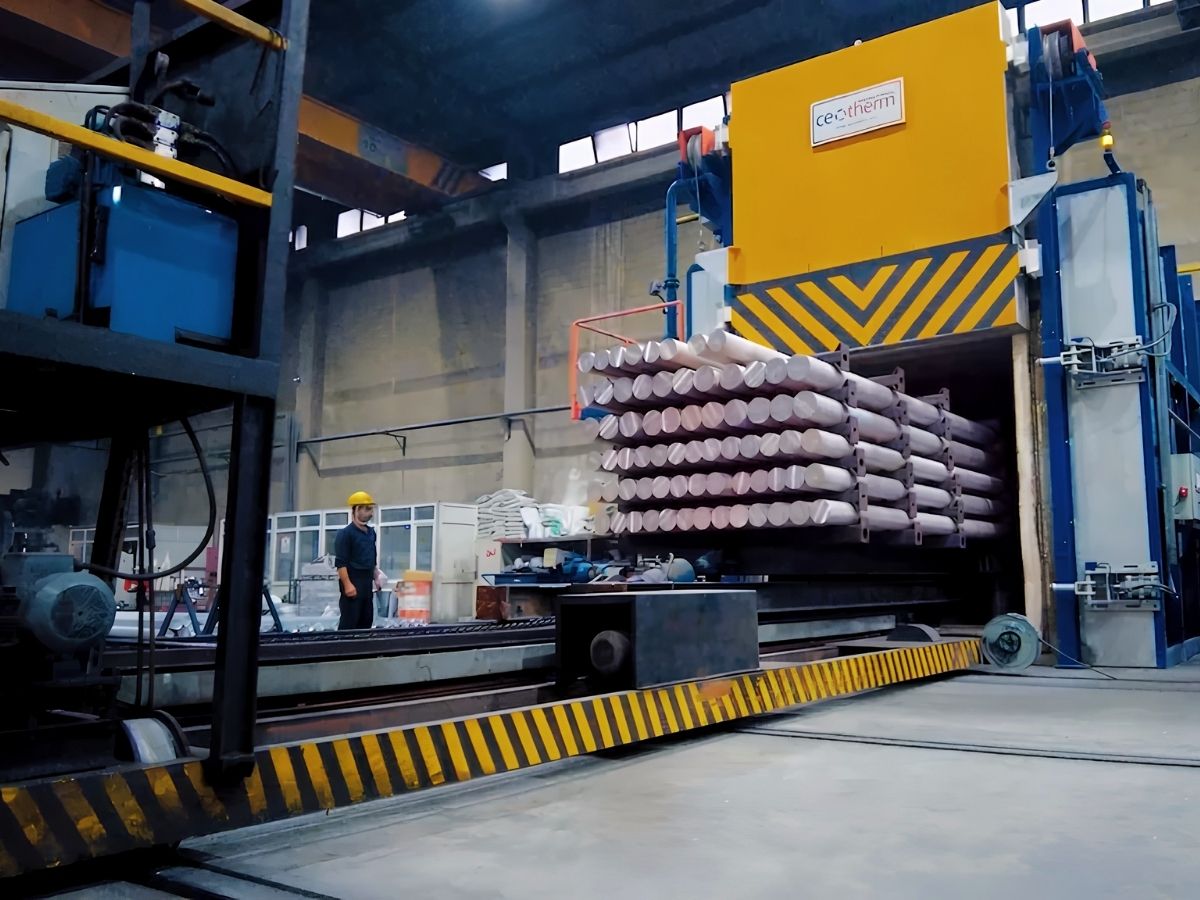
Homogenization is a controlled heat treatment process in which the aluminium billet is heated to specific temperatures after casting and then cooled in a controlled manner.
The goal is to eliminate microstructural inhomogeneities formed during casting and ensure a more uniform distribution of alloying elements throughout the billet.
During aluminium alloy casting, the following may occur:
-
Chemical segregation
-
Localized concentration of alloying elements
-
Undesirable intermetallic phases
-
Non-uniform grain structures
Homogenization reduces these variations and creates a stable and uniform microstructure.
Therefore, aluminium homogenization is not just a heat treatment process but a critical step in optimizing extrusion performance.
Why Is Homogenization Performed in Aluminium Billets?
Although a billet may appear flawless externally, its internal structure can vary significantly. These differences can cause problems during extrusion.
The main objectives of homogenization are:
1. Reducing chemical segregation
During casting, elements such as magnesium, silicon, or manganese may distribute unevenly.
This can lead to:
-
Surface defects in profiles
-
Variations in mechanical properties
-
Increased die wear
Homogenization ensures a more uniform distribution of elements.
2. Improving extrusion performance
Homogenized billets:
-
Flow more consistently
-
Require lower pressing force
-
Enable higher production speeds
This increases efficiency and reduces energy consumption.
3. Improving surface quality
Common defects such as:
-
Surface streaks
-
Surface stains
-
Flow lines
-
Color variations
can be significantly reduced with proper homogenization.
4. Balancing mechanical properties
An inhomogeneous microstructure may cause:
-
Strength variations
-
Hardness inconsistencies
-
Processing difficulties
Homogenization stabilizes mechanical properties.
What Happens During Homogenization?
At the microscopic level, homogenization involves several metallurgical processes:
Dissolution
Some phases formed during casting are re-dissolved.
This allows alloying elements to distribute more uniformly within the matrix.
Diffusion
Atoms move at high temperatures, reducing concentration gradients.
Phase transformations
Undesirable coarse phases break down and redistribute.
Stress relief
Internal stresses formed during casting are reduced.
This improves formability during extrusion.
Impact of Homogenization on the Extrusion Process
In an extrusion line, billet quality determines overall process stability.
Advantages of homogenized billets:
| Parameter | Homogenized Billet | Non-Homogenized Billet |
|---|---|---|
| Metal flow | Uniform | Irregular |
| Press force | Lower | Higher |
| Die life | Longer | Shorter |
| Surface quality | Better | Poorer |
| Production speed | Higher | Lower |
| Scrap rate | Lower | Higher |
These differences directly impact production costs, especially in architectural and industrial profiles.
Which Alloys Require Homogenization the Most?
Homogenization can be applied to all aluminium alloys, but it is particularly critical in certain groups.
6xxx Series Alloys
The most commonly used extrusion alloys:
-
6060
-
6061
-
6063
-
6005
-
6082
Uniform distribution of magnesium and silicon is essential.
2xxx Series Alloys
High-strength copper-containing alloys.
Homogenization improves control of mechanical properties.
7xxx Series Alloys
High-performance zinc-based alloys.
Widely used in aerospace and defense applications.
Homogenization Temperature and Duration
Parameters depend on the specific alloy.
Typically:
-
Temperature range: 500 °C – 620 °C
-
Duration: several hours up to 24 hours
-
Controlled cooling required
Excessively high temperatures may cause:
-
Grain growth
-
Surface defects
-
Loss of mechanical properties
Insufficient time may result in incomplete homogenization.
Quality Control of Homogenization
Professional billet manufacturers perform several tests after homogenization:
-
Chemical analysis
-
Metallographic examination
-
Electrical conductivity measurement
-
Hardness testing
-
Ultrasonic inspection
These tests ensure that the billet meets extrusion requirements.
Standards in the Context of Homogenization
The following standards are commonly referenced in the aluminium industry:
-
EN 573 (chemical composition)
-
EN 755 (extruded products)
-
EN 12020 (architectural profiles)
-
ISO 9001 (quality management)
These standards do not define homogenization directly but require controlled and repeatable production processes.
Checklist for High-Quality Homogenization
When sourcing billets, the following points should be verified:
Technical checklist
✓ Alloy certificates available
✓ Homogenization process applied
✓ Temperature records available
✓ Controlled cooling system
✓ Chemical analysis reports documented
✓ Microstructure inspections performed
✓ Regular quality testing
✓ Traceability ensured
Manufacturer’s Perspective on Homogenization
Many issues in aluminium profile production originate before extrusion, within the internal structure of the billet.
Therefore, modern manufacturers invest not only in casting quality but also heavily in homogenization technology.
A properly executed aluminium homogenization process leads to:
-
More stable extrusion
-
Higher surface quality
-
Lower scrap rate
-
Longer die life
-
More consistent mechanical properties
Conclusion
The question “what is homogenization in aluminium billet?” describes one of the fundamental processes in modern extrusion technology. Through controlled heat treatment after casting, alloying elements are distributed uniformly, improving extrusion performance and stabilizing final product quality.
The quality of aluminium profiles in architecture, automotive, and industrial applications heavily depends on the quality of the billet used. Therefore, precise control of the homogenization process is essential for efficient and sustainable production.
Technical Support for Billet and Extrusion Processes
Biser Alüminyum provides integrated production solutions from casting to extrusion, delivering high-quality aluminium billets and profile systems in compliance with international standards.
For technical support on alloy selection, billet quality, or extrusion optimization, feel free to contact us.