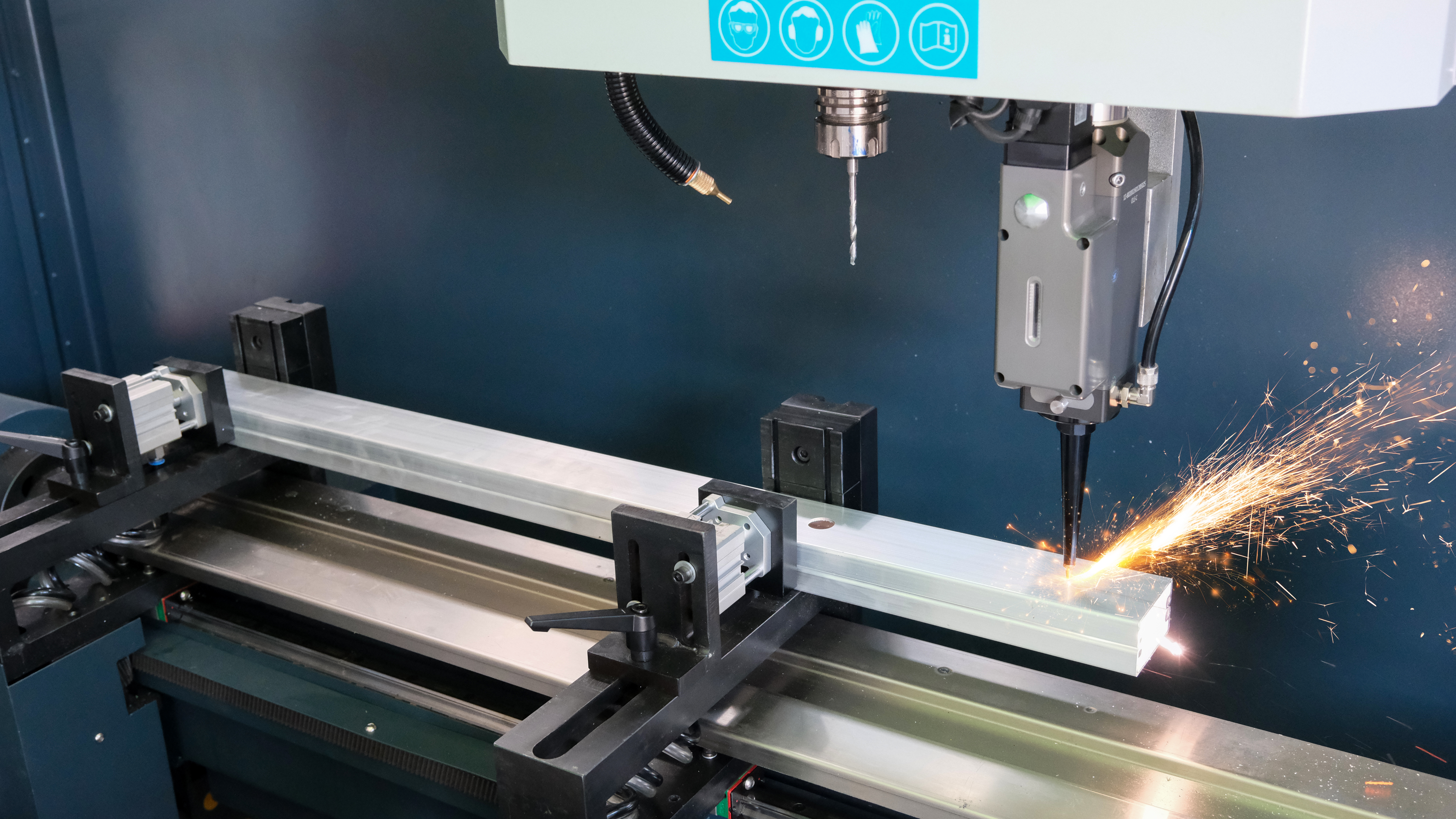
What Is Aluminum Machining? A Complete Guide to Cutting, Drilling, Milling, and Bending
Aluminum machining refers to the manufacturing processes performed after extrusion or casting to transform aluminum profiles and components into finished products ready for their intended applications. Operations such as cutting, drilling, milling, and bending enable standard aluminum profiles to become functional parts used in architectural systems, machinery, automotive applications, solar energy systems, and many other industries.
In B2B manufacturing, producing high-quality aluminum profiles alone is not enough. Precision machining is equally important because it simplifies assembly, reduces production costs, and improves the overall performance of the final product. For this reason, machining capability is one of the key factors to consider when selecting an aluminum extrusion manufacturer.
This guide explains what aluminum machining is, the most common machining methods, essential quality considerations, and the factors businesses should evaluate when choosing a manufacturing partner.
What Is Aluminum Machining?
Aluminum machining encompasses all machining and forming operations performed after extrusion, casting, or rolling to achieve the required dimensions, geometry, and assembly features of aluminum components.
Typical machining operations include:
-
Cutting profiles to the required length
-
Drilling holes for fasteners
-
Milling slots, pockets, and channels
-
Bending profiles into specific shapes
-
Producing assembly-ready components
Integrating machining processes into production significantly improves both efficiency and product quality, particularly in high-volume manufacturing.
Why Is Aluminum Machining Necessary?
Standard aluminum extrusion profiles rarely meet final application requirements without additional processing. Depending on the intended use, profiles must be customized through various machining operations.
Common applications include:
-
Drilling connection holes for curtain wall systems
-
Precision cutting for solar mounting structures
-
Milling channels for machine frames
-
Angle cutting for furniture profiles
-
Creating mounting features for industrial equipment
Proper aluminum machining offers several important benefits:
-
Faster assembly
-
Lower labor costs
-
Improved dimensional accuracy
-
Consistent production quality
-
Reduced manufacturing errors
For large production volumes, CNC machining centers provide maximum efficiency and repeatability.
Common Types of Aluminum Machining
| Machining Process | Purpose | Typical Applications |
|---|---|---|
| Cutting | Profile sizing | Architectural and industrial systems |
| Drilling | Creating fastening points | Machinery and automotive |
| Milling | Producing slots, pockets, and surfaces | Industrial equipment |
| Bending | Forming profiles | Architecture and furniture |
| Thread Tapping | Creating internal threads | Mechanical assemblies |
| Countersinking | Preparing screw seats | Precision assemblies |
Aluminum Cutting
Cutting is one of the most fundamental machining operations. It determines the final length of the aluminum profile and directly affects subsequent assembly processes.
Common cutting methods include:
-
Circular saw cutting
-
Carbide-tipped saw blades
-
Double-head cutting machines
-
CNC automatic cutting systems
Factors Affecting Cutting Quality
-
Aluminum alloy
-
Temper condition
-
Saw blade speed
-
Feed rate
-
Cooling system
-
Blade tooth geometry
Incorrect cutting parameters may result in:
-
Burr formation
-
Profile deformation
-
Dimensional inaccuracies
-
Damage to anodized or powder-coated surfaces
For this reason, automated cutting and measurement systems are widely used in modern production facilities.
Aluminum Drilling
Drilling is performed to create holes for bolts, screws, rivets, and other fastening components.
Key factors affecting drilling quality include:
-
Drill geometry
-
Cutting speed
-
Feed rate
-
Chip evacuation
-
Coolant application
Thin-walled aluminum extrusion profiles should always be securely clamped to prevent deformation during drilling.
Modern CNC machining centers can produce multiple hole patterns in a single operation, significantly improving productivity.
Aluminum Milling
Milling is one of the most precise machining operations used to create complex geometries on aluminum profiles.
Typical milling operations include:
-
Slot milling
-
Pocket milling
-
Pin holes
-
Surface machining
-
Connection details
Architectural window, door, and curtain wall profiles often require extensive milling operations before assembly.
Factors Influencing Milling Quality
-
Cutting tool quality
-
CNC machine accuracy
-
Proper fixturing
-
Optimized cutting parameters
-
Tool wear management
High-speed CNC machining centers can produce excellent surface finishes while maintaining tight tolerances.
Aluminum Bending
Not all aluminum profiles are used in straight forms. Many industries require profiles to be bent into specific radii without compromising structural integrity.
Typical applications include:
-
Curtain wall systems
-
Railings
-
Bus and railway components
-
Furniture manufacturing
-
Decorative architectural elements
The most important objective during bending is preventing profile deformation.
Potential defects include:
-
Ovalization
-
Cracking
-
Buckling
-
Cross-section distortion
Proper tooling and support systems help minimize these risks.
Advantages of CNC Machining Centers
Manual machining processes are increasingly being replaced by CNC-controlled manufacturing.
Key advantages include:
-
High dimensional accuracy
-
Consistent repeatability
-
Lower rejection rates
-
Faster production
-
Reduced operator error
-
Ability to machine complex geometries
-
Digital production monitoring
-
Cost-effective mass production
For large-scale projects, CNC technology significantly reduces total manufacturing costs.
The Importance of Alloy Selection
Not all aluminum alloys offer the same machinability.
| Alloy | Machinability | Common Applications |
|---|---|---|
| EN AW-6060 | Excellent | Architectural profiles |
| EN AW-6063 | Excellent | Window and door systems |
| EN AW-6061 | Good | Machinery components |
| EN AW-6082 | Good | Heavy-duty industrial applications |
| EN AW-6005 | Good | Solar mounting systems |
Selecting the appropriate alloy helps improve:
-
Tool life
-
Machining efficiency
-
Surface quality
-
Overall production costs
Key Factors Affecting Machining Quality
Modern equipment alone does not guarantee excellent machining results.
Several factors must work together.
Raw Material Quality
High-quality aluminum billets provide consistent material properties and improve machining performance.
Extrusion Quality
Dimensionally accurate extrusion profiles allow more precise machining operations.
Workpiece Fixturing
Proper clamping minimizes vibration and improves surface finish.
Tool Management
Worn cutting tools may cause:
-
Burr formation
-
Dimensional deviations
-
Poor surface quality
Process Planning
An optimized machining sequence improves production efficiency and reduces cycle times.
Dimensional Accuracy and Quality Control
Machined aluminum components are evaluated according to several quality criteria, including:
-
Overall dimensions
-
Hole locations
-
Parallelism
-
Squareness
-
Surface roughness
-
Burr inspection
-
Geometric tolerances
Manufacturers typically produce components according to customer drawings and specifications while considering applicable EN and ISO standards where required. General tolerances are often referenced according to ISO 2768, while quality management systems commonly follow ISO 9001 principles.
Machining Before or After Surface Finishing?
Depending on the project requirements, machining can be performed either before or after powder coating.
Machining Before Powder Coating
Advantages include:
-
Lower risk of surface damage
-
Machined surfaces receive coating protection
-
More economical production
Machining After Powder Coating
Advantages include:
-
Higher dimensional accuracy
-
Required for certain precision applications
However, protective fixtures should be used to prevent damage to finished surfaces.
What Should You Consider When Choosing a Manufacturing Partner?
Price should never be the only selection criterion when sourcing aluminum machining services.
Important considerations include:
-
CNC machining capacity
-
Cutting and milling capabilities
-
Experience in aluminum extrusion
-
Inspection and quality control systems
-
Integrated manufacturing capabilities
-
On-time delivery performance
-
Technical engineering support
-
Flexibility for custom projects
Manufacturers capable of handling extrusion, machining, and surface finishing under one roof often provide significant advantages in terms of quality consistency, logistics, and lead times.
Practical Checklist
Before selecting an aluminum machining supplier, consider the following:
☐ Does the company operate modern CNC machining centers?
☐ Are machining tolerances documented?
☐ Can inspection reports be provided?
☐ Is aluminum extrusion performed in-house?
☐ Can machining and powder coating be coordinated within the same facility?
☐ Does the company have sufficient production capacity for large-scale projects?
☐ Is technical support available based on engineering drawings?
☐ Can multiple aluminum alloys be processed?
☐ Are delivery schedules consistently met?
☐ Are standardized quality control procedures in place?
Conclusion
Aluminum machining involves much more than cutting, drilling, milling, and bending. It is a critical manufacturing process that directly influences product functionality, assembly efficiency, and long-term performance. Precision machining, high-quality raw materials, and robust quality control ensure reliable and cost-effective production.
For B2B manufacturers, working with a supplier that offers integrated production—from aluminum billet manufacturing and aluminum extrusion to CNC machining and powder coating—can streamline the supply chain and improve overall project efficiency.
Biser Aluminum provides integrated manufacturing solutions covering aluminum billet production, extrusion, machining, powder coating, and value-added processing services. If you would like technical support or a customized quotation for your aluminum profile project, our engineering team will be pleased to assist you.