What Are T5 and T6? Differences Between T5 and T6 Aluminum Tempers
When purchasing aluminum profiles or reviewing product specifications, you will frequently encounter the terms T5 and T6. These designations refer to specific heat-treatment conditions that influence the mechanical properties of aluminum. Particularly in 6000 series aluminum alloys such as 6060, 6061, 6063, and 6082, temper selection plays an important role in determining strength, hardness, ductility, and suitability for different applications.
So, what are T5 and T6, what are the differences between T5 and T6 aluminum tempers, and which temper should you choose?
In this article, we explain the concept of aluminum temper, the T5 and T6 heat-treatment processes, the key differences between them, and the factors to consider when selecting the appropriate temper for your application.
What Is Aluminum Temper?
Aluminum temper refers to the condition of an alloy resulting from the thermal and/or mechanical treatments applied during or after manufacturing. The temper designation is closely related to the material's mechanical properties, including tensile strength, yield strength, hardness, and elongation.
Aluminum tempers are generally identified by codes consisting of letters and numbers. For example:
-
6063-T5: Aluminum made from the 6063 alloy that has been cooled after extrusion and artificially aged.
-
6063-T6: Aluminum made from the 6063 alloy that has undergone solution heat treatment followed by artificial aging.
-
6061-T6: Aluminum made from the 6061 alloy and heat-treated to meet the requirements of the T6 temper.
In these examples, 6063 and 6061 identify the alloy composition, while T5 and T6 indicate the temper condition resulting from the processing route.
Therefore, the alloy designation alone is not sufficient to determine all the mechanical properties of a product. The alloy and temper must be evaluated together.
What Is T5? Properties of T5 Aluminum Temper
T5 is a temper in which aluminum is cooled after a high-temperature shaping process, such as extrusion, and then artificially aged.
T5 is widely used in 6000 series aluminum extrusion alloys, particularly in aluminum profile manufacturing.
How Does the T5 Heat-Treatment Process Work?
The main stages of the T5 process are as follows:
-
Extrusion: A heated aluminum billet is forced through a steel die to produce the required profile cross-section.
-
Cooling: The extruded profile is cooled under conditions appropriate to the alloy and manufacturing process.
-
Artificial aging: The profile is heated in a controlled environment for a specified time and temperature to achieve the required mechanical properties.
-
Quality control: The finished product is evaluated against the applicable technical specifications and subjected to the required mechanical tests.
The cooling conditions immediately after extrusion are particularly important for T5 temper. These conditions influence the mechanical properties that can be achieved through subsequent artificial aging.
What Are the Advantages of T5 Aluminum Temper?
-
It can be integrated into the production flow following extrusion.
-
With a suitable alloy and controlled processing conditions, it can provide the required mechanical properties for architectural and industrial profiles.
-
It allows the aging process to be integrated into the extrusion production line.
-
It can be used in a variety of structural and commercial profile applications when the design and temper requirements are appropriately specified.
The suitability of T5 depends on the alloy, product geometry, required mechanical properties, and applicable standards.
What Is T6? Properties of T6 Aluminum Temper
T6 is a temper achieved by solution heat treating an aluminum alloy, rapidly cooling it, and then artificially aging it.
This process helps develop mechanical properties such as strength and hardness in suitable alloys. T6 is commonly selected for aluminum profiles and industrial applications where higher mechanical performance is required.
How Does the T6 Heat-Treatment Process Work?
The main stages of the T6 process are as follows:
-
Extrusion: An aluminum billet is forced through a die to produce the required profile shape.
-
Solution heat treatment: The profile is heated to an appropriate temperature for a specified period to dissolve soluble alloying elements into the solid solution.
-
Rapid cooling: The material is rapidly cooled using an appropriate method. This stage is critical to achieving the intended mechanical properties.
-
Artificial aging: The profile is held at a controlled temperature for a specified period to develop the required mechanical properties.
-
Quality control: The final product is checked against the specified mechanical properties, dimensional tolerances, and customer requirements.
Solution heat treatment and rapid cooling are the key process steps that distinguish T6 from T5.
What Are the Advantages of T6 Aluminum Temper?
-
It enables higher strength levels to be achieved in suitable alloys.
-
It is used in structural and industrial aluminum profiles.
-
It supports the controlled development of mechanical properties in accordance with relevant standards and technical requirements.
-
With the correct alloy and processing conditions, it can be suitable for demanding operating environments.
However, T6 is not necessarily better than T5 for every application. Actual performance must be evaluated based on the alloy and the applicable product standard.
What Are the Differences Between T5 and T6 Aluminum?
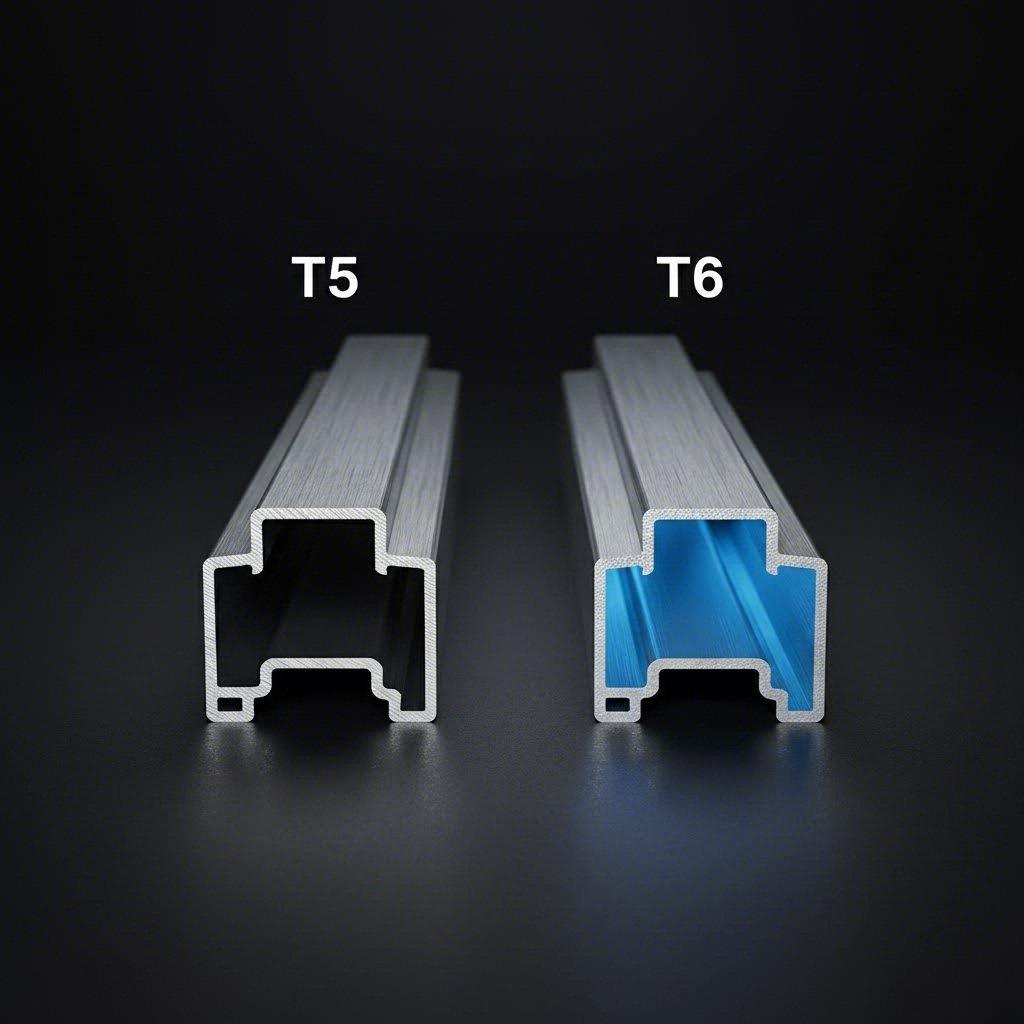
The main difference between T5 and T6 lies in the heat-treatment sequence applied to the aluminum. This difference affects the manufacturing process and the mechanical properties that can be achieved.
| Comparison criterion | T5 Temper | T6 Temper |
|---|---|---|
| Main process | Cooling after high-temperature shaping, followed by artificial aging | Solution heat treatment, rapid cooling, and artificial aging |
| Separate solution heat-treatment step | Not required by the T5 temper definition | Required |
| Strength | Depends on the alloy and processing conditions | Depends on the alloy and processing conditions |
| Manufacturing approach | Aging can be integrated into the extrusion line or performed separately | Requires solution heat treatment and artificial aging |
| Applications | Architectural and industrial extrusion profiles | Architectural and industrial profiles requiring specific strength levels |
| Selection criteria | Required mechanical properties and manufacturing conditions | Required mechanical properties and manufacturing conditions |
Important note: Although T6 is often selected to achieve higher strength in many applications, it does not automatically provide higher strength for every alloy or profile section. Comparisons should be based on the same alloy, product form, applicable standard, and specified mechanical property requirements.
T5 or T6: Which Aluminum Temper Should You Choose?
The right temper depends on the intended application and the technical requirements the product must meet.
When Should T5 Be Considered?
T5 may be a suitable option in the following situations:
-
Architectural door, window, and façade systems.
-
General-purpose aluminum extrusion profiles.
-
Applications in which the required mechanical properties can be achieved in the T5 condition.
-
Production processes where cooling after extrusion and artificial aging can be efficiently integrated into the manufacturing flow.
However, not every architectural profile must be produced in T5 temper. Profile design, load-bearing requirements, and customer specifications determine the appropriate choice.
When Should T6 Be Considered?
T6 may be suitable for applications such as:
-
Industrial profiles requiring higher strength.
-
Machinery and equipment components.
-
Aluminum parts with load-bearing or structural functions.
-
Projects in which the technical specification explicitly requires T6 temper.
Even in these cases, relying on the T6 designation alone is not sufficient. The product must meet the required tensile strength, yield strength, elongation, and dimensional requirements.
What Should You Consider When Selecting an Aluminum Temper?
Before placing an order, the following criteria should be evaluated:
-
Alloy grade: Such as 6060, 6061, 6063, or 6082.
-
Required tensile and yield strength.
-
Minimum elongation.
-
Profile cross-section and wall thickness.
-
Applicable product standards and customer technical specifications.
-
Subsequent manufacturing operations: Such as welding, bending, or machining.
-
Surface treatment and final operating conditions.
Considering these factors together helps ensure that the selected temper meets the requirements of the intended application.
T5 and T6 in 6060, 6061, 6063, and 6082 Aluminum Alloys
The 6000 series aluminum alloys contain magnesium and silicon and can be strengthened through heat treatment. However, their mechanical properties and typical applications differ.
6060: Commonly considered for architectural extrusion profiles and products with complex cross-sections. Surface finish and extrudability are important selection criteria.
6061: Used in various industrial applications where strength and machinability are important. T6 is one of its widely used temper conditions.
6063: Widely used in architectural aluminum profiles, door and window systems, and decorative extrusion applications. It can be produced in T5 and T6 tempers under suitable processing conditions.
6082: Considered for certain structural and industrial applications requiring higher strength. The appropriate temper and profile dimensions should be selected according to the required mechanical properties.
There is no single temper that is best for every application. Chemical composition, extrusion conditions, cooling rate, aging parameters, and product geometry all influence the final properties.
Why Is Heat Treatment Important in Aluminum Extrusion?
The objective of aluminum extrusion is not simply to produce the desired profile cross-section. The product must also meet the required mechanical properties, dimensional specifications, and intended application requirements.
Extrusion temperature, die design, profile geometry, and cooling conditions can all affect the mechanical properties achievable in 6000 series alloys. Proper control of the heat-treatment process helps the product reach the specified temper condition.
Correct application of T5 and T6 tempers requires the manufacturing parameters, alloy characteristics, and quality-control results to be evaluated together. In particular, when manufacturing to technical specifications, it is important to define the required mechanical properties clearly rather than specifying only the temper designation.
At Biser Aluminium, we recognize the importance of defining technical specifications that meet customer requirements and the intended application throughout the billet and extrusion profile manufacturing processes.
Frequently Asked Questions About T5 and T6 Aluminum
1. What is the main difference between T5 and T6?
T5 refers to aluminum that is cooled after a high-temperature shaping process and then artificially aged. T6 refers to aluminum that has undergone solution heat treatment, rapid cooling, and subsequent artificial aging.
2. Is T6 aluminum stronger than T5?
Not in every case. T6 is commonly used to achieve higher strength in many alloys, but actual values depend on the alloy, profile geometry, processing conditions, and applicable standard. Comparisons should be based on the specified mechanical properties of the same alloy.
3. What is the difference between 6063-T5 and 6063-T6?
Both designations refer to the 6063 alloy. The difference lies in the heat-treatment sequence and the resulting mechanical properties. 6063-T5 is produced through cooling after extrusion followed by artificial aging, while 6063-T6 involves solution heat treatment, rapid cooling, and artificial aging.
4. Where are T5 aluminum profiles used?
T5 aluminum profiles can be used in architectural systems, door and window profiles, and various general-purpose extrusion applications. Their suitability depends on the required mechanical properties and project specifications.
5. Which industries use T6 aluminum?
T6 aluminum is used in machinery, equipment, industrial profiles, automotive applications, and various structural components. The alloy and product specifications must be selected according to the requirements of each application.
6. Can T5 and T6 tempers be applied to all aluminum alloys?
No. Temper selection depends on the alloy's heat-treatability and the applicable product standard. T5 and T6 are particularly common in suitable 6000 series extrusion alloys.
7. Does the aluminum temper designation alone indicate product quality?
No. The temper designation identifies the material's processing condition but does not, by itself, guarantee every aspect of product quality. Chemical composition, mechanical test results, dimensional tolerances, and surface quality must also be evaluated.
Conclusion: The Right Temper for the Right Application
T5 and T6 are two important aluminum temper conditions that influence the mechanical properties of aluminum alloys. T5 involves cooling after a high-temperature shaping process followed by artificial aging, whereas T6 involves solution heat treatment, rapid cooling, and artificial aging.
When choosing between these tempers, it is important to consider not only strength values but also the intended application, alloy grade, profile geometry, and technical specifications.
For your aluminum billet and extrusion profile requirements, contact Biser Aluminium to discuss the alloy grades and manufacturing options suitable for your project.