Aluminium Anodizing Colours and Coating Thickness: A Technical Selection Guide
Aluminium is widely used in architectural and industrial applications thanks to its lightweight structure, durability and suitability for various surface treatments. However, in applications such as façades, door and window systems, cladding and decorative profiles, mechanical properties alone are not sufficient. Protecting the surface against environmental conditions and achieving the desired appearance are equally important.
Aluminium anodizing is an electrochemical surface treatment used to meet these requirements. Available in natural, bronze, black, gold and various metallic shades, anodizing creates a controlled oxide layer on the aluminium surface. The thickness of this layer is determined by the intended application, expected corrosion resistance and aesthetic requirements.
What are the available aluminium anodizing colours? How many microns should an anodized coating be? Which coating thickness is suitable for outdoor applications?
This guide explores anodizing types, colour options, technical thickness classes and the key factors to consider when selecting the right surface treatment.
1. What Is Aluminium Anodizing?
Anodizing is a surface treatment process in which the aluminium surface is intentionally oxidized through an electrolytic process. Also known as anodic oxidation, the process involves placing the aluminium component as an anode in a suitable electrolyte solution. When an electric current is applied, an aluminium oxide (Al₂O₃) layer forms on the surface.
This layer is thicker and more controlled than the naturally occurring oxide film, improving the surface properties of aluminium.
The main functions of anodizing include:
-
Corrosion resistance: Helps protect the aluminium surface against environmental effects and oxidation.
-
Wear resistance: Increases surface hardness and improves resistance to mechanical wear.
-
Aesthetic appearance: Offers different colour, gloss and surface texture options.
-
Surface integrity: The coating is formed by converting the aluminium surface itself; it does not create a separate paint film like conventional painting.
Anodizing performance depends on more than coating thickness. The aluminium alloy, surface preparation, process parameters and final pore-sealing process also affect the quality of the finished coating.
2. What Are the Different Aluminium Anodizing Colours?
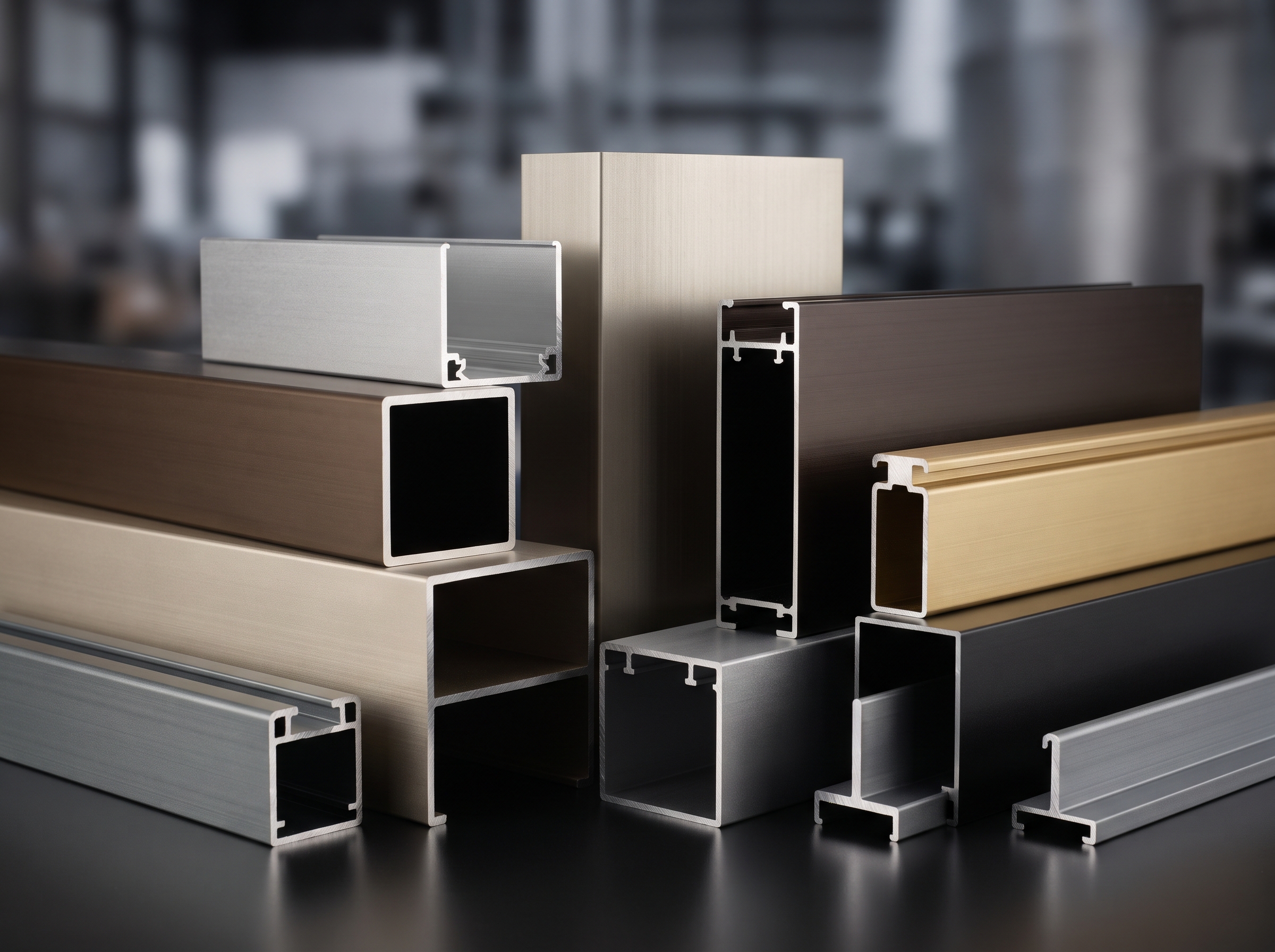
Anodized aluminium colours vary depending on the colouring method and the characteristics of the aluminium surface. The most common options in architectural applications include natural, bronze, black, gold and stainless-steel-like metallic finishes.
The oxide layer formed during anodizing has a porous structure. These pores allow different shades to be achieved through specific colouring methods.
2.1. Natural Anodizing
Natural anodizing preserves the natural metallic appearance of aluminium, generally resulting in silver or light grey tones.
In this process, the oxide layer is sealed without adding colour. As a result, the characteristic metallic appearance of aluminium is largely maintained.
Common applications:
-
Aluminium door and window profiles
-
Façade systems
-
Interior architectural profiles
-
Industrial aluminium components
-
Decorative building elements
Natural anodizing is widely used in architectural projects where a simple, metallic appearance is preferred.
2.2. Bronze Anodizing
Bronze anodizing is available in a range of shades, from light bronze to dark bronze and brown.
The colour is achieved through a colouring process carried out after anodizing. In electrolytic colouring, metallic salts are used to create colour within the pores of the oxide layer.
Bronze anodizing gives architectural systems a warmer and more decorative appearance.
Common applications:
-
Aluminium joinery systems
-
Façade cladding
-
Glass façade applications
-
Decorative aluminium profiles
-
Commercial and residential projects
The exact shade of bronze may vary depending on the production parameters and colouring method.
2.3. Black Anodizing
Black anodizing is an anodic oxidation process in which the aluminium surface is given a black finish.
The colour is generally achieved by impregnating the pores of the oxide layer with organic or inorganic dyes, or by using electrolytic colouring methods.
Black anodizing is popular in contemporary architectural designs because it creates contrast while preserving the metallic character of the surface.
Common applications:
-
Black aluminium window and door systems
-
Modern façade designs
-
Furniture and decorative profiles
-
Lighting components
-
Industrial aluminium parts
For outdoor applications, the UV resistance of the colouring agent and the coating thickness should be assessed in addition to the colour itself.
2.4. Gold Anodizing
Gold anodizing creates a metallic gold or champagne appearance on the aluminium surface.
Depending on the colouring technique, the finish can range from light champagne shades to more pronounced gold tones.
Common applications:
-
Decorative architectural profiles
-
Interior design elements
-
Furniture accessories
-
Retail and commercial spaces
-
Custom-designed aluminium systems
Colour consistency is particularly important when different profile sections are used within the same project.
2.5. Stainless-Steel-Look and Metallic Anodizing
Finishes referred to as stainless-steel-look anodizing can be produced in silver, grey or brushed metallic shades that resemble stainless steel.
The appearance is influenced not only by the colouring method but also by pre-treatment processes such as sandblasting or mechanical brushing.
Common applications:
-
Architectural façade systems
-
Interior decoration
-
Elevator and decorative construction profiles
-
Furniture systems
-
Commercial interior designs
Comparison of Anodizing Colours
| Anodizing colour | Appearance | Common applications |
|---|---|---|
| Natural | Silver, light grey | Doors, windows and façades |
| Light bronze | Light brown | Architectural joinery |
| Dark bronze | Dark brown | Façades and decoration |
| Black | Metallic black | Modern architectural systems |
| Gold | Gold, champagne | Decorative profiles |
| Stainless-steel look | Silver, brushed metal | Interiors and façades |
Important: Colour names and codes used for anodized finishes may vary between manufacturers. Two finishes offered under the same colour name are not necessarily identical. For large-scale projects, approval of a physical sample before production is recommended.
3. What Is Anodizing Thickness? How Many Microns Are Required?
Anodizing thickness refers to the thickness of the oxide layer formed on the aluminium surface, measured in micrometres (µm).
One micron is equal to one-thousandth of a millimetre.
The required anodizing thickness depends on the application, environmental conditions, expected corrosion resistance and aesthetic requirements.
Under ISO 7599, anodic coatings are classified according to their average coating thickness.
ISO 7599 Anodizing Thickness Classes
| Coating class | Minimum average thickness | Minimum local thickness |
|---|---|---|
| AA 5 | 5 µm | 4 µm |
| AA 10 | 10 µm | 8 µm |
| AA 15 | 15 µm | 12 µm |
| AA 20 | 20 µm | 16 µm |
| AA 25 | 25 µm | 20 µm |
The AA designation indicates the thickness class of the anodic oxidation coating.
For example, an AA 15 coating has a minimum average thickness of 15 microns and a minimum local thickness of 12 microns.
Average coating thickness and the thickness measured at a single point are not the same. Therefore, technical specifications should define not only the average thickness but also the minimum local thickness where required.
3.1. Differences Between 5, 10, 15, 20 and 25 Micron Anodizing
As anodizing thickness increases, the potential for corrosion protection may also increase under suitable process conditions. However, a higher micron value does not automatically guarantee better results for every application.
-
5-micron anodizing: May be used for certain decorative applications and situations requiring a lower level of protection.
-
10-micron anodizing: Can be considered for applications exposed to relatively limited environmental conditions.
-
15-micron anodizing: One of the commonly specified thickness classes in architectural applications.
-
20-micron anodizing: May be preferred for outdoor applications requiring greater environmental resistance.
-
25-micron anodizing: Can be considered for applications with higher protection or specific performance requirements.
These values are general technical references, not universal or mandatory choices for every application. The final thickness should be determined according to the relevant standards, environmental exposure and project specifications.
4. Which Anodizing Thickness Is Suitable for Indoor and Outdoor Applications?
The environment in which an aluminium profile will be used is one of the most important factors when selecting anodizing thickness.
A decorative profile used indoors does not necessarily require the same surface treatment as a façade profile exposed to humidity and salt in a coastal environment.
The following table can be used as an initial reference during technical selection.
| Application | Thickness to consider |
|---|---|
| Indoor decorative profiles | 5–10 µm |
| General architectural applications | 10–15 µm |
| External façades and window systems | 15–20 µm |
| Coastal areas and harsh industrial environments | 20–25 µm or as specified by the project |
This table is a preliminary selection guide, not a mandatory standard requirement.
For projects in coastal areas, increasing the coating thickness alone may not be sufficient. Alloy selection, surface preparation, sealing quality and maintenance conditions should also be taken into account.
5. Factors Affecting Anodizing Colour and Coating Quality
Even when the same anodizing colour and coating thickness are specified, the appearance and surface quality may vary between different aluminium profiles.
This is mainly because the anodizing process is directly affected by the surface characteristics of aluminium.
5.1. Aluminium Alloy
The chemical composition of aluminium is an important factor affecting the colour and surface uniformity achieved after anodizing.
The anodizing performance of extrusion alloys such as 6060, 6063 and 6082 may vary depending on their chemical composition and metallurgical structure.
The amounts of iron, silicon, magnesium and other elements in the alloy can influence the surface tone and appearance.
For this reason, alloy selection should be evaluated before production, particularly for natural and light-coloured anodized finishes.
5.2. Surface Preparation
Surface preparation before anodizing directly affects the appearance of the finished product.
Common surface preparation methods include:
-
Mechanical polishing: Used to achieve smoother and glossier surfaces.
-
Brushing: Creates a linear and decorative texture on the aluminium surface.
-
Sandblasting: Helps produce a more matte and uniform appearance.
-
Chemical etching: Used to remove certain surface irregularities and create a matte finish.
Selecting the appropriate surface preparation method helps reduce visual differences between profiles with the same specified colour.
5.3. Colouring Method
The colouring technique used after anodizing also determines the available colours and performance characteristics.
The most common methods include:
-
Electrolytic colouring: Metallic deposits are formed within the pores of the oxide layer to produce shades such as bronze and black.
-
Dye colouring: Organic or inorganic dyes are absorbed into the pores of the oxide layer to create different colours.
-
Integral colouring: Special electrolytes and process conditions are used to produce colour as the oxide layer forms.
Each method offers different colour options, production conditions and outdoor performance characteristics.
5.4. Sealing
The oxide layer formed during anodizing has a porous structure. Sealing these pores is important for the coating's corrosion resistance and overall performance.
The sealing process makes the coating structure more stable and helps protect it against environmental effects.
Errors during this stage may lead to staining, colour changes and reduced performance.
6. How Is Anodizing Thickness Measured?
Different measurement methods are used to determine whether the anodizing thickness complies with the technical specification.
The methods include:
Eddy Current Method – ISO 2360
This is a non-destructive method used to measure the thickness of non-conductive coatings on conductive materials such as aluminium.
It is commonly used for anodizing measurements. The measuring instrument should be calibrated using suitable reference standards.
Microscopic Cross-Section Method – ISO 1463 / ISO 9220
This method determines coating thickness by examining a cross-section under a microscope. It can be used for more detailed inspection and, where necessary, reference measurements.
Split-Beam Microscope Method – ISO 2128
This is another method used to determine the thickness of an anodic oxide layer.
Measurements should not rely on a single point alone. Different areas of the profile should also be assessed. Selecting appropriate measurement points is particularly important for long aluminium extrusion profiles.
7. What Is the Difference Between Anodizing and Powder Coating?
Anodizing and electrostatic powder coating are two commonly used surface treatment methods for aluminium profiles.
Both methods are used to protect the surface and achieve a desired appearance. However, their working principles and resulting surface properties are different.
| Feature | Anodizing | Electrostatic powder coating |
|---|---|---|
| Application method | Electrochemical oxidation | Electrostatic paint application |
| Surface structure | Aluminium oxide layer | Polymer coating film |
| Appearance | Metallic surface character | Matte, glossy or textured |
| Colour options | Specific anodizing colours | Wide range of RAL colours |
| Coating thickness | Generally specified in micron classes | Specified as a separate paint film thickness |
| Metallic appearance | Preserves the metallic character of aluminium | Depends on the paint formulation |
Anodizing is preferred when preserving the natural metallic appearance of aluminium is important. Powder coating offers advantages in projects requiring a wider range of colours and different surface effects.
Therefore, the choice between these methods should consider not only aesthetic expectations but also the application environment, technical requirements and maintenance conditions.
8. What Should Be Considered When Ordering Anodized Aluminium Profiles?
Defining a surface treatment only by its colour name may lead to uncertainty during production.
Technical expectations should be clearly specified at the ordering stage, particularly for large-volume projects and projects carried out in different countries.
The following information should be included in an aluminium profile order:
-
Aluminium alloy: Specify the alloy and temper.
-
Anodizing colour: Define whether natural, bronze, black or a special colour is required.
-
Coating thickness: Specify the relevant thickness class, such as AA 10, AA 15 or AA 20.
-
Surface appearance: Define whether a matte, glossy, brushed or sandblasted finish is required.
-
Colour tolerance: Specify acceptable colour variations and approve a reference sample.
-
Standards and quality requirements: Include ISO 7599, relevant project specifications and QUALANOD requirements where applicable.
-
Inspection method: Define the tests to be used for coating thickness and surface quality.
To maintain colour consistency between different profile sections used in the same project, it is preferable to use the same alloy, similar surface preparation and consistent production conditions wherever possible.
9. Relevant Standards for Aluminium Anodizing
International standards and industry quality requirements provide important references for evaluating anodizing quality.
Key standards and quality documents include:
-
ISO 7599: Specification of decorative and protective anodic oxidation coatings on aluminium and its alloys.
-
ISO 2360: Measurement of coating thickness using the eddy current method.
-
ISO 1463: Measurement of metallic and oxide coating thickness by microscopic examination of cross-sections.
-
QUALANOD: An industry quality programme defining quality requirements and inspection principles for architectural anodizing.
ISO 7599 covers topics such as coating thickness, surface appearance, test methods and the suitability of aluminium alloys for anodizing.
QUALANOD is an important reference for evaluating the production process and final coating quality, particularly in architectural anodizing applications.
The standards and certification requirements specified for a project should be confirmed with the manufacturer before placing an order.
10. Frequently Asked Questions
How many microns should aluminium anodizing be?
Anodizing thickness varies according to the application. ISO 7599 includes classes such as AA 5, AA 10, AA 15, AA 20 and AA 25. Thicknesses of 15–20 microns may be considered for outdoor and architectural applications. The final selection should be based on environmental conditions and project specifications.
Which anodizing colour is the most durable?
Colour alone does not directly determine durability. Coating thickness, colouring method, UV resistance of the colouring agent, sealing quality and production conditions should all be evaluated together.
Does black anodizing fade in sunlight?
The resistance of black anodizing to sunlight depends on the colouring agent and production process. For outdoor applications, colouring systems with verified lightfastness should be preferred.
What is the difference between natural anodizing and painted aluminium?
In natural anodizing, an oxide layer is created on the aluminium surface through an electrochemical process, preserving its metallic appearance. In painted aluminium, a separate paint film is applied to the surface. Therefore, the surface structures and appearances are different.
Can anodized aluminium be scratched?
Anodizing creates a harder surface than the natural oxide layer of aluminium. However, it is not completely scratch-proof. Contact with hard or sharp objects may cause scratches or damage to the coating.
Can anodized aluminium be used on external façades?
Yes. Anodized aluminium can be used in façade systems when suitable alloy selection, surface preparation, coating thickness and sealing conditions are ensured. More detailed technical assessment is necessary in aggressive environments such as coastal areas.
Are anodizing and anodic oxidation the same process?
Yes. Anodizing is the commonly used English term for the electrochemical process known as anodic oxidation.
Conclusion
Aluminium anodizing colours and coating thicknesses are important technical factors that influence both the appearance and performance of a profile.
Colour options such as natural, bronze, black and gold complement different architectural designs, while coating classes such as AA 10, AA 15, AA 20 and AA 25 address different protection requirements.
Selecting the right anodizing finish requires more than choosing a colour or micron value. Aluminium alloy, surface preparation, colouring method, sealing quality and the environmental conditions of the application should all be evaluated together.