Think about aluminum: lightweight, durable, corrosion-resistant… Yet when it is in its molten state, it encounters its greatest enemy: Hydrogen.
When moisture in the air comes into contact with molten aluminum, it dissociates, and the released hydrogen gas easily dissolves into the liquid metal. Much like the condensation droplets forming on the outside of a cold glass of water, this gas attempts to escape as the molten metal begins to solidify. However, if the metal has already started to freeze, the gas bubbles become trapped inside the structure.
These microscopic trapped bubbles later appear as porosity within the internal structure of the aluminum profiles we produce. Such voids reduce the mechanical strength of the profile, deteriorate surface quality, and cause undesirable defects during processes such as anodizing or powder coating.
In other words, an invisible enemy becomes one of the greatest killers of quality.
Nitrogen Degassing: A Transparent Cleaning Operation
So how do we eliminate this invisible enemy?
The answer lies in a remarkably simple yet highly effective process:
Nitrogen Degassing
Imagine the process:
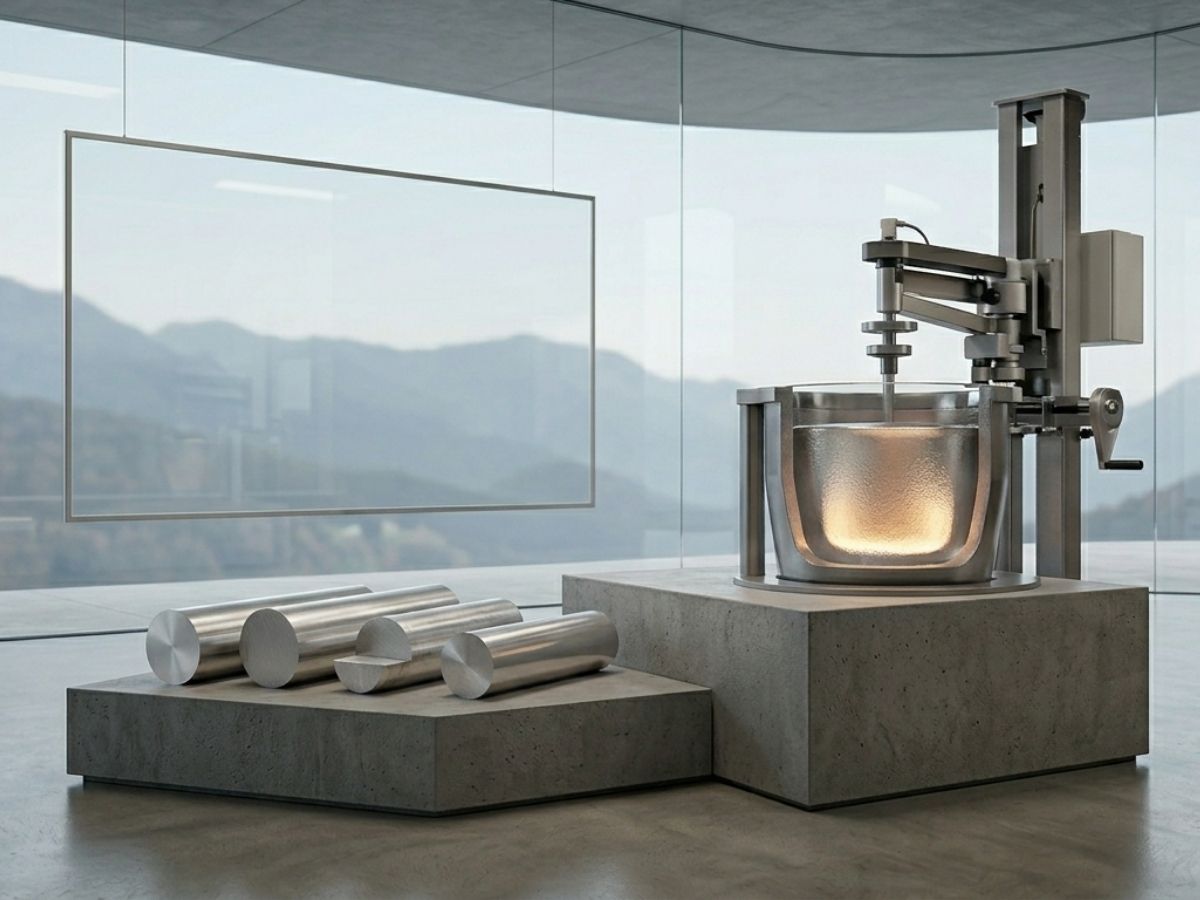
We are about to cast a large aluminum billet. Inside our furnace, molten aluminum at approximately 700–750°C is ready. However, a certain amount of dissolved hydrogen is still present inside the melt.
This is where a specially designed rotor system comes into play.
The rotor is immersed into the molten metal and begins rotating at high speed, while pure nitrogen gas is injected through it.
Thanks to the rotating rotor, the nitrogen gas disperses into millions of tiny bubbles throughout the molten aluminum.
At this stage, a fundamental law of physics takes over:
Partial pressure difference.
Initially, the nitrogen bubbles contain no hydrogen at all. As a result, the hydrogen dissolved in the molten aluminum is naturally drawn toward these nitrogen bubbles, almost as if magnetized. The hydrogen diffuses into the bubbles, and as the bubbles rise toward the surface, they collect more hydrogen along the way.
Finally, when the bubbles reach the surface of the melt, they burst and release the hydrogen into the atmosphere.
What Benefits Does This Process Provide?
The reason we apply this process so carefully is directly related to the satisfaction of our valued customers.
Superior Mechanical Properties
A billet free from internal porosity possesses a homogeneous structure.
This homogeneity allows the metal to flow more consistently during the aluminum extrusion process and ensures that the final profile achieves the desired mechanical properties such as:
- Tensile strength
- Structural durability
- Consistent performance
Flawless Surface Quality
Profiles produced from billets that have not undergone proper degassing may exhibit rough surfaces resembling an orange peel texture, or small surface streaks caused by trapped gas bubbles.
This is completely unacceptable for architectural aluminum profiles where visual appearance is critical.
Thanks to our degassing process, your aluminum profiles maintain:
- Smooth surfaces
- Bright appearance
- High aesthetic quality
Suitability for Advanced Surface Treatments
Surface finishing processes such as:
- Anodizing
- Powder coating
are extremely sensitive to the subsurface structure of the metal.
Even the smallest trapped gas bubble may expand during anodizing and cause defects commonly referred to as:
- Burning
- Staining
- Surface blemishes
Degassing eliminates these risks and provides a clean surface suitable even for the highest-quality finishing applications.
Improved Weldability
In applications where aluminum profiles must be welded together — such as welded structural systems — internal porosity can lead to defects within the weld seam itself.
Clean metal means:
- Stronger welds
- More reliable joints
- Better structural integrity
The Biser Aluminum Difference: Transparency at Every Stage of the Process
At Biser Aluminum, we do not consider nitrogen degassing to be an ordinary production step.
We see it as one of the most critical quality control points in the entire aluminum billet casting process.
This is because the amount of dissolved gas within the molten metal directly affects:
- The internal structure of the billet
- The extrusion behavior
- The final performance of the aluminum profile
For this reason, we continuously monitor critical process parameters such as:
- Rotor speed
- Nitrogen flow rate
- Nitrogen purity
to ensure that every casting operation is carried out with the same level of stability and precision.
Our goal is simple:
To achieve a predictable, homogeneous, and reliable billet structure in every production batch.