At What Temperature Do Metals Melt? A Comparison Table of Melting Points
Knowing the temperature at which metals melt is essential for the proper planning and control of casting, metallurgy, welding, heat treatment, recycling, and manufacturing processes. Each metal has a different melting point, depending on its atomic structure and chemical composition. Therefore, metals such as aluminium, iron, copper, zinc, magnesium, and titanium do not melt at the same temperature.
For manufacturers working specifically with aluminium and aluminium alloys, melting temperature is one of the fundamental process parameters in aluminium billet production, casting, alloying, and melting operations. For example, pure aluminium melts at approximately 660°C, while the melting and solidification behaviour of aluminium alloys can change depending on the alloying elements added to the material.
In this article, we compare the melting points of different metals, explain why aluminium melts at a relatively low temperature, and examine key metallurgical characteristics through a metal melting point comparison table.
What Is the Melting Point of a Metal?
The melting point is the temperature at which a substance begins to change from a solid state to a liquid state. When a metal reaches a certain temperature, the effect of the bonds between its atoms decreases, and its crystal structure begins to break down.
Pure metals generally have a specific melting point, whereas alloys behave differently. Alloys often do not melt or solidify at a single temperature but rather over a specific temperature range.
For example, the melting point of pure aluminium is approximately 660.3°C. However, aluminium alloys such as 6060, 6061, 6063, and 6082 contain elements including magnesium, silicon, iron, copper, and others, which can alter their melting behaviour compared with pure aluminium.
For this reason, in industrial manufacturing, it is not enough to ask simply, "At what temperature does a metal melt?" It is also necessary to consider factors such as the specific alloy, its chemical composition, and the production process.
Metal Melting Point Comparison Table
The following table shows the approximate melting points of several commonly used metals.
| Metal | Symbol | Melting Point (°C) | Melting Point (°F) |
|---|---|---|---|
| Mercury | Hg | -38.8°C | -37.8°F |
| Tin | Sn | 231.9°C | 449.4°F |
| Lead | Pb | 327.5°C | 621.5°F |
| Zinc | Zn | 419.5°C | 787.1°F |
| Magnesium | Mg | 650°C | 1,202°F |
| Aluminium | Al | 660.3°C | 1,220.5°F |
| Silver | Ag | 961.8°C | 1,763°F |
| Gold | Au | 1,064.2°C | 1,947.5°F |
| Copper | Cu | 1,084.6°C | 1,984.3°F |
| Iron / Iron-Based Materials* | Fe | ~1,538°C | ~2,800°F |
| Titanium | Ti | 1,668°C | 3,034°F |
| Chromium | Cr | 1,907°C | 3,465°F |
| Nickel | Ni | 1,455°C | 2,651°F |
| Tungsten | W | 3,422°C | 6,192°F |
*The approximate value given for iron refers to the melting point of pure iron. The melting and solidification temperatures of alloys such as cast iron and steel vary depending on their chemical composition.
As the table shows, there are significant differences between the melting temperatures of metals. For example, tin melts at approximately 232°C, while tungsten has a melting point above 3,400°C.
At What Temperature Does Aluminium Melt?
The melting point of pure aluminium is approximately 660.3°C.
This relatively low melting temperature is important because it helps explain why aluminium can be melted at lower temperatures than many iron-based metals in manufacturing and recycling processes.
However, the material used in industrial aluminium production is not always pure aluminium. Various alloying elements are added to achieve specific mechanical properties and manufacturing performance.
For example, some of the most widely used alloys in the aluminium extrusion industry include:
-
6060
-
6061
-
6063
-
6082
These alloys have different chemical compositions from pure aluminium.
Therefore, the melting and solidification ranges of aluminium alloys are not necessarily identical to the 660.3°C melting point of pure aluminium.
At What Temperature Does 6063 Aluminium Melt?
6063 aluminium alloy is one of the most widely used alloys, particularly for architectural and industrial aluminium extrusion applications.
While 6063 consists primarily of aluminium, it also contains alloying elements, particularly magnesium and silicon. These elements influence the alloy's mechanical properties, extrudability, surface quality, and melting and solidification behaviour.
For this reason, it is more accurate to discuss a melting range rather than a single melting temperature for 6063 aluminium. The exact temperature range of a commercial alloy may vary depending on its chemical composition.
The same principle applies to other aluminium alloys. In casting processes, particularly, liquidus temperature, solidus temperature, and casting temperature are different concepts and should not be treated as the same thing.
Why Does Aluminium Melt at a Lower Temperature Than Some Other Metals?
The main reason aluminium has a lower melting point than metals such as iron, nickel, titanium, or tungsten is related to its atomic and crystal structure.
Aluminium has a face-centered cubic (FCC) crystal structure. The characteristics of its metallic bonds and crystal structure determine the amount of energy required for aluminium to transition from a solid to a liquid state.
This characteristic is also one of aluminium's important industrial advantages.
A relatively lower melting temperature can contribute to:
-
Reduced energy consumption
-
Easier control of melting processes
-
More efficient recycling operations
-
More economical casting processes
However, the melting point alone is not sufficient when controlling an industrial production process. Furnace temperature, alloy chemical composition, holding time, oxidation, degassing, and casting conditions can all directly affect the quality of the final product.
At What Temperature Does Iron Melt?
The melting point of pure iron is approximately 1,538°C.
However, most iron-based materials used in everyday life and industry are not pure iron. Materials such as steel and cast iron contain carbon and other alloying elements.
For this reason, steel does not have a single universal melting temperature. As the carbon content and the concentration of other alloying elements change, the solidus and liquidus temperatures also change.
This demonstrates why chemical composition is so important in metallurgical manufacturing, just as it is with aluminium alloys.
At What Temperature Does Copper Melt?
The melting point of pure copper is approximately 1,084.6°C.
Copper is widely used in electrical, electronics, energy, and various industrial applications because of its high electrical and thermal conductivity.
However, the melting behaviour of copper alloys may differ from that of pure copper. Alloys such as brass and bronze contain elements including zinc, tin, and others.
Therefore, it is not always accurate to determine the melting temperature of a material simply by looking at its primary metal.
At What Temperature Does Zinc Melt?
The melting point of zinc is approximately 419.5°C.
This is significantly lower than the melting point of aluminium. Zinc's relatively low melting temperature provides important advantages in certain manufacturing methods, such as die casting.
Zinc is also widely used in galvanizing processes to protect steel against corrosion.
At What Temperature Does Magnesium Melt?
Pure magnesium melts at approximately 650°C.
The melting point of magnesium is relatively close to that of aluminium. However, magnesium's low density makes it particularly valuable for automotive, aerospace, and various engineering applications where weight reduction is important.
The melting behaviour of magnesium alloys can vary depending on the amount and type of alloying elements and the chemical composition of the material.
At What Temperature Do Gold and Silver Melt?
The melting point of pure gold is approximately 1,064°C, while pure silver melts at approximately 962°C.
In addition to their value as precious metals, gold and silver can also be used in various technical applications because of properties such as high electrical and thermal conductivity.
The melting temperatures of pure gold and silver are not necessarily the same as those of the alloys used in jewellery and industrial applications. Alloying elements can change both the physical properties and melting behaviour of the material.
What Factors Affect the Melting Point of a Metal?
The melting behaviour of a metal or metal alloy is not determined solely by the type of element listed on the periodic table.
1. Chemical Composition
As the proportions of elements within an alloy change, the solidus and liquidus temperatures can also change.
In aluminium alloys, the concentrations of elements such as silicon, magnesium, copper, zinc, and iron are particularly important.
2. Alloy Structure
The melting behaviour of a pure metal differs from that of an alloy. Pure metals generally melt at a specific temperature, whereas alloys often melt and solidify over a temperature range.
3. Pressure
Under normal industrial conditions, the effect of pressure is generally limited. However, under high-pressure conditions, the phase transformation temperatures of a material may change.
4. Heating Rate
Laboratory measurements and industrial furnace processes do not operate under identical conditions. Heating rate, temperature distribution, and the position of the material within the furnace can influence process behaviour.
5. Oxidation and Surface Conditions
For metals with a high affinity for oxygen, such as aluminium, the oxide layer that forms on the surface must be considered during the manufacturing process.
Melting Point and Casting Temperature Are Not the Same
One of the most common mistakes in metallurgy is to consider the melting point and casting temperature as the same thing.
A metal's melting point is a physical property related to the transition from the solid phase to the liquid phase. However, simply melting the metal is not sufficient for manufacturing.
For casting to take place effectively, the molten metal must have appropriate fluidity. Therefore, the actual temperature used in a production process may be higher than the material's nominal melting point.
The same principle applies to aluminium billet casting. Simply knowing that "aluminium melts at 660°C" is not sufficient. Furnace temperature, metal temperature, alloy composition, casting system, cooling conditions, and solidification rate must all be evaluated together.
Why Is Melting Temperature Important in Aluminium Billet Production?
Aluminium billet is one of the primary starting materials used in the extrusion process. Billet quality can directly influence the efficiency of subsequent extrusion operations and the properties of the final aluminium profile.
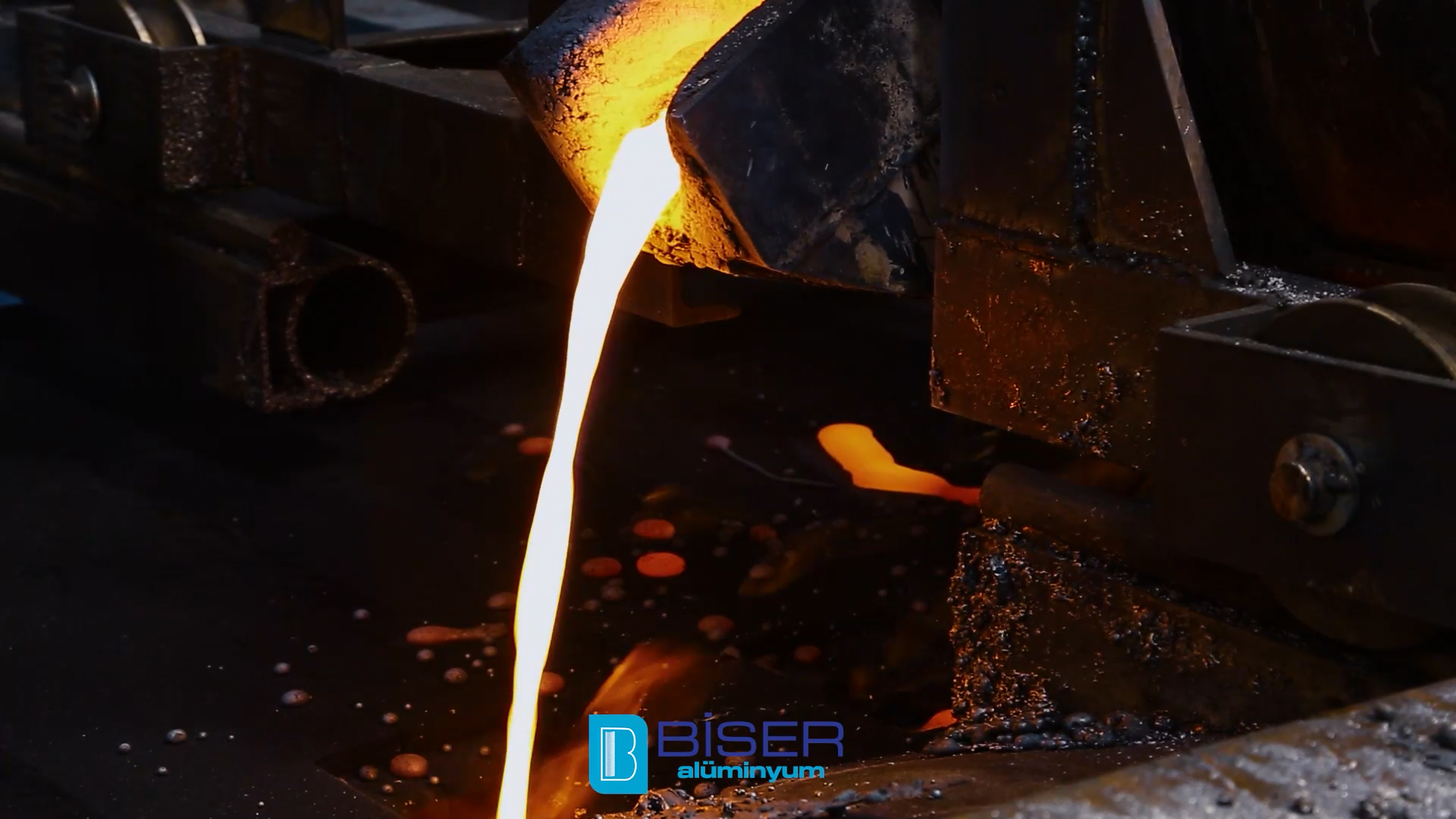
During billet production, after aluminium scrap or primary aluminium is melted, the alloy composition must be controlled. Chemical analysis is performed, and the required alloying elements are adjusted to achieve the target alloy specification.
Important production parameters include:
-
Chemical composition
-
Metal temperature
-
Melting time
-
Degassing
-
Filtration
-
Casting speed
-
Cooling conditions
-
Homogenization
-
Billet surface quality
For products such as 6063, 6061, and 6082 aluminium billets intended for extrusion, maintaining control over the chemical composition is particularly important for process consistency and repeatability.
Why Is the Melting Point Important for Manufacturers?
Information about a metal's melting point is not merely theoretical metallurgical knowledge. It is directly or indirectly used throughout many stages of manufacturing.
For example:
Casting: Helps determine the appropriate metal temperature for the process.
Recycling: Helps plan the process conditions required for melting scrap metal.
Welding: Helps evaluate the localized temperatures generated during the welding process.
Extrusion: Contributes to a better understanding of billet homogenization and preheating processes.
Energy Management: Helps assess the energy requirements of furnaces and melting operations.
Material Selection: Helps compare the high-temperature performance of different metals.
Frequently Asked Questions
At What Temperature Does Aluminium Melt?
Pure aluminium has a melting point of approximately 660.3°C. The melting and solidification temperatures of aluminium alloys vary depending on their chemical composition.
At What Temperature Does 6063 Aluminium Melt?
Since 6063 is an alloy, it is not accurate to define it by a single melting point in the same way as pure aluminium. Depending on its chemical composition, it has a specific melting and solidification range.
At What Temperature Does Iron Melt?
The melting point of pure iron is approximately 1,538°C. The melting temperatures of iron-based alloys such as steel and cast iron vary depending on their composition.
At What Temperature Does Copper Melt?
The melting point of pure copper is approximately 1,084.6°C.
At What Temperature Does Zinc Melt?
Pure zinc melts at approximately 419.5°C.
Which Metal Has the Highest Melting Point?
Among commonly known metals, tungsten has one of the highest melting points, at approximately 3,422°C.
Which Metal Has the Lowest Melting Point?
Mercury has a melting point of approximately -38.8°C and is therefore liquid at room temperature.
Conclusion: Why Is It Important to Know Metal Melting Points?
The answer to the question "At what temperature does a metal melt?" depends on the type of metal and whether the material is pure or alloyed. Pure aluminium melts at approximately 660°C, while copper melts at around 1,085°C, iron at approximately 1,538°C, and tungsten at approximately 3,422°C.
However, knowing the melting points of pure metals alone is not sufficient for industrial manufacturing. In the aluminium industry, particularly, the chemical compositions, melting and solidification ranges, casting conditions, and production parameters of alloys such as 6060, 6061, 6063, and 6082 must all be evaluated together.
When aluminium's relatively low melting point is considered alongside its low density, high corrosion resistance, good electrical and thermal conductivity, and excellent recyclability, it becomes easier to understand why aluminium is one of the most important materials in modern industry.
Biser Aluminium provides solutions tailored to the technical requirements of different industries through the production of aluminium billets and aluminium profiles. Throughout the manufacturing process, key parameters such as alloy composition, billet quality, and the technical requirements of the extrusion process are carefully controlled.