Aluminum Billet Quality Control: Chemical Analysis, Certification and EN Standards
In the aluminum extrusion industry, the quality of the final profile starts long before the extrusion press. One of the most critical factors affecting product performance, surface quality, mechanical properties, and production efficiency is the quality of the aluminum billet used in manufacturing.
For manufacturers, contractors, architects, system suppliers, and industrial buyers, understanding aluminum billet quality control processes is essential when selecting a reliable supplier. Chemical composition verification, process monitoring, certification requirements, and compliance with EN and ISO standards all play a significant role in ensuring consistent product quality.
This article explains the key aspects of aluminum billet quality control, including chemical analysis procedures, certification practices, traceability systems, and relevant European standards.
What Is an Aluminum Billet?
An aluminum billet is a cylindrical semi-finished product produced through the casting process and used as the primary raw material in aluminum extrusion.
During extrusion, billets are heated and forced through a die to create profiles with specific cross-sections. Since every profile originates from a billet, any inconsistency in billet quality directly impacts the final product.
High-quality billets contribute to:
-
Improved extrusion efficiency
-
Better surface quality
-
Reduced scrap rates
-
Consistent mechanical properties
-
Enhanced anodizing performance
-
Better powder coating results
-
Stable dimensional tolerances
For this reason, billet quality control should begin at the earliest stages of production.
Why Billet Quality Control Matters
Even minor deviations in alloy composition or internal structure can create significant manufacturing challenges.
Potential issues caused by poor billet quality include:
-
Surface defects
-
Extrusion cracking
-
Die lines
-
Dimensional instability
-
Mechanical property variations
-
Increased production waste
-
Reduced productivity
Quality control helps prevent these problems before the billet enters the extrusion process.
For industrial buyers, selecting a billet supplier with robust quality management systems can significantly reduce production risks and overall costs.
Key Stages of Aluminum Billet Quality Control
Modern billet production facilities implement quality controls throughout the entire manufacturing process.
The main stages typically include:
| Inspection Stage | Purpose |
|---|---|
| Raw material inspection | Verify input material quality |
| Melting process control | Ensure alloy consistency |
| Spectrometric analysis | Confirm chemical composition |
| Casting inspection | Monitor internal quality |
| Homogenization control | Improve microstructure |
| Dimensional inspection | Verify tolerances |
| Certification | Confirm compliance |
Each stage contributes to producing billets that meet customer specifications and international standards.
Chemical Analysis: The Foundation of Quality Assurance
Chemical composition is one of the most important quality indicators for aluminum billets.
The performance of an aluminum alloy depends on the precise balance of alloying elements.
Commonly monitored elements include:
-
Silicon (Si)
-
Magnesium (Mg)
-
Iron (Fe)
-
Manganese (Mn)
-
Copper (Cu)
-
Zinc (Zn)
-
Chromium (Cr)
-
Titanium (Ti)
For example:
-
Silicon improves extrusion characteristics.
-
Magnesium increases strength.
-
Excessive iron may negatively affect surface quality.
-
Copper can influence mechanical performance.
Because even small variations can impact product quality, chemical analysis is performed continuously throughout billet production.
Spectrometric Analysis in Billet Manufacturing
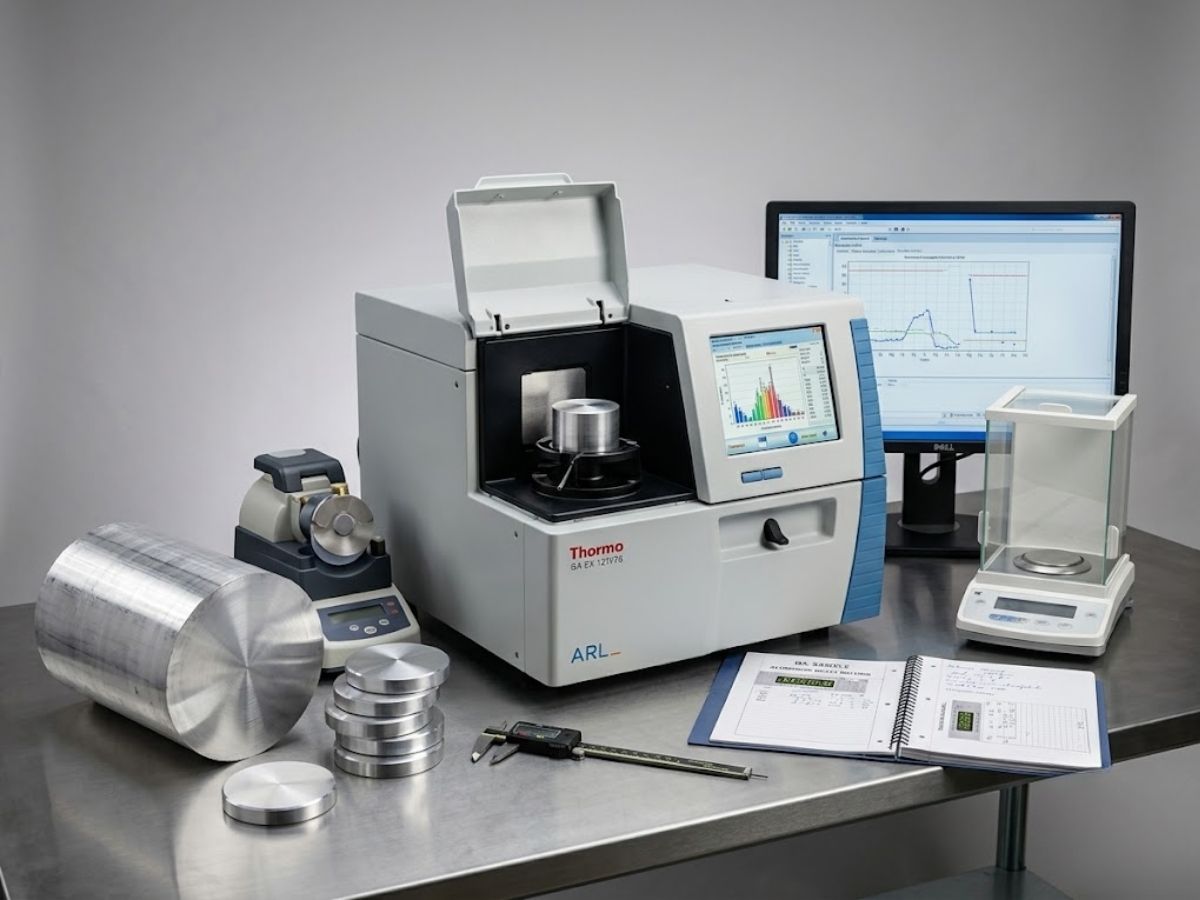
Optical Emission Spectrometry (OES) is one of the most widely used methods for analyzing aluminum alloys.
This technology allows manufacturers to measure chemical composition within seconds and compare results against target specifications.
Spectrometric analysis is typically performed:
-
Before casting
-
During production
-
After alloy adjustments
-
During quality verification
Results are documented and stored for future traceability.
This process ensures that each production batch meets alloy requirements before proceeding to casting operations.
Common Aluminum Alloys Used for Extrusion
Several aluminum alloys dominate the extrusion market.
Popular billet alloys include:
EN AW-6060
Widely used in architectural applications due to excellent surface quality and anodizing performance.
EN AW-6063
Preferred for decorative and architectural profiles requiring smooth finishes.
EN AW-6005
Provides higher mechanical strength while maintaining good extrusion characteristics.
EN AW-6082
Used in structural and engineering applications where high strength is required.
Each alloy has specific chemical composition limits defined by European standards.
Quality control procedures verify compliance with these limits throughout production.
The Importance of Homogenization
After casting, billets typically undergo a homogenization process.
Homogenization involves heating billets to controlled temperatures for a specific period before cooling under controlled conditions.
The objectives include:
-
Reducing segregation
-
Improving alloy distribution
-
Enhancing extrusion performance
-
Improving mechanical properties
-
Increasing process stability
Without proper homogenization, extrusion defects and inconsistent product performance may occur.
For high-quality billet production, homogenization is considered an essential process rather than an optional step.
Dimensional and Visual Inspection
Chemical analysis alone does not guarantee billet quality.
Physical inspections are equally important.
Quality control teams typically evaluate:
-
Billet diameter
-
Length tolerances
-
Ovality
-
Surface condition
-
Cracks
-
Segregation marks
-
Foreign inclusions
-
Casting defects
Billets that fail dimensional or visual inspections are removed before reaching extrusion operations.
This helps prevent costly production interruptions.
EN Standards for Aluminum Billets
European standards provide a common quality framework for aluminum manufacturers and buyers.
Some of the most relevant standards include:
| Standard | Scope |
|---|---|
| EN 573 | Chemical composition |
| EN 755 | Extruded products |
| EN 515 | Temper designations |
| EN 12020 | Precision extrusions |
| EN 1706 | Casting alloys |
Compliance with these standards helps ensure product consistency across international markets.
For export-oriented manufacturers, adherence to EN standards is often a customer requirement.
The Role of ISO Standards
While EN standards define product requirements, ISO standards focus on management systems and process control.
ISO 9001
ISO 9001 establishes requirements for quality management systems.
Benefits include:
-
Process consistency
-
Continuous improvement
-
Documentation control
-
Customer satisfaction
ISO 14001
Focuses on environmental management systems.
ISO 45001
Addresses occupational health and safety management.
Manufacturers operating under internationally recognized ISO systems often demonstrate higher levels of operational control and traceability.
Certification and Traceability
Modern industrial buyers increasingly require full traceability.
Every billet batch should be linked to documented production records.
Typical traceability information includes:
-
Production date
-
Alloy designation
-
Chemical analysis results
-
Homogenization records
-
Lot numbers
-
Quality inspection reports
Traceability provides confidence that materials meet project requirements and allows rapid investigation if issues arise.
This is particularly important in sectors such as:
-
Construction
-
Transportation
-
Automotive
-
Renewable energy
-
Industrial manufacturing
Aluminum Billet Supplier Evaluation Checklist
Before selecting a billet supplier, buyers should consider the following questions:
✔ Are chemical analysis reports available?
✔ Are alloy specifications documented?
✔ Is homogenization controlled and recorded?
✔ Does production comply with EN standards?
✔ Is batch traceability maintained?
✔ Are quality inspections performed regularly?
✔ Are certification systems in place?
✔ Can technical documentation be provided for export projects?
A positive answer to these questions is often an indicator of a reliable supplier.
Billet Quality from a Manufacturer's Perspective
For extrusion manufacturers, billet quality directly affects operational efficiency.
High-quality billets typically result in:
-
Higher extrusion speeds
-
Better profile quality
-
Reduced waste
-
Improved productivity
-
Lower production costs
-
Greater customer satisfaction
Therefore, billet quality control should be viewed as a comprehensive system rather than a final inspection activity.
At Biser Aluminum, billet production processes are supported by chemical analysis, process monitoring, homogenization control, and quality verification procedures designed to support consistent extrusion performance and product quality.
Conclusion
Aluminum profile quality begins with billet quality. Chemical analysis, homogenization, dimensional inspection, certification, and compliance with EN and ISO standards all contribute to producing reliable and consistent aluminum billets.
For companies operating in architectural, industrial, transportation, and engineering sectors, working with a supplier that prioritizes quality control can significantly improve manufacturing efficiency and product performance.
If you would like technical information about aluminum billet specifications, alloy selection, extrusion applications, or quality requirements, contact the Biser Aluminum team for professional support and tailored solutions.