Aluminum Billet Diameter Selection: A Comparison of 5", 6", 7", 8" and 9" Diameters
In aluminum extrusion manufacturing, selecting the right aluminum billet diameter is an important technical decision that directly affects production efficiency, press capacity, extrusion speed, die performance, metal flow, and final profile quality. Aluminum billets with diameters of 5", 6", 7", 8", and 9" are used for different extrusion presses, profile cross-sections, and production requirements.
Although it may seem that a larger-diameter billet simply contains more metal and that a smaller-diameter billet is suitable for smaller profiles, billet diameter selection is actually much more complex. Press container diameter, extrusion ratio, profile cross-sectional area, die design, alloy type, target production speed, and order volume must all be considered together.
In this comprehensive guide, we will compare 5-inch, 6-inch, 7-inch, 8-inch, and 9-inch aluminum billet diameters, examine which diameter is more suitable for different applications, and explain how to select the right billet diameter for aluminum extrusion manufacturing.
Why Is Aluminum Billet Diameter So Important?
An aluminum billet is one of the primary raw materials used in the extrusion process. The billet is placed into the container of an extrusion press and forced through a die under high pressure to produce the desired aluminum profile cross-section.
Billet diameter is therefore one of the starting points of the entire process.
Selecting an inappropriate billet diameter can result in:
- Inefficient use of press capacity
- Unsuitable extrusion ratios
- Low or difficult-to-control extrusion speeds
- Unbalanced metal flow
- Unnecessary loads on the die
- Surface quality problems
- Increased scrap rates
- Higher production costs
For this reason, billet diameter should not be selected simply by asking, "Which diameter is larger?" The more important question is:
Which billet diameter is technically and economically the most suitable for this profile, alloy, and production volume?
What Do 5", 6", 7", 8" and 9" Aluminum Billet Diameters Mean?
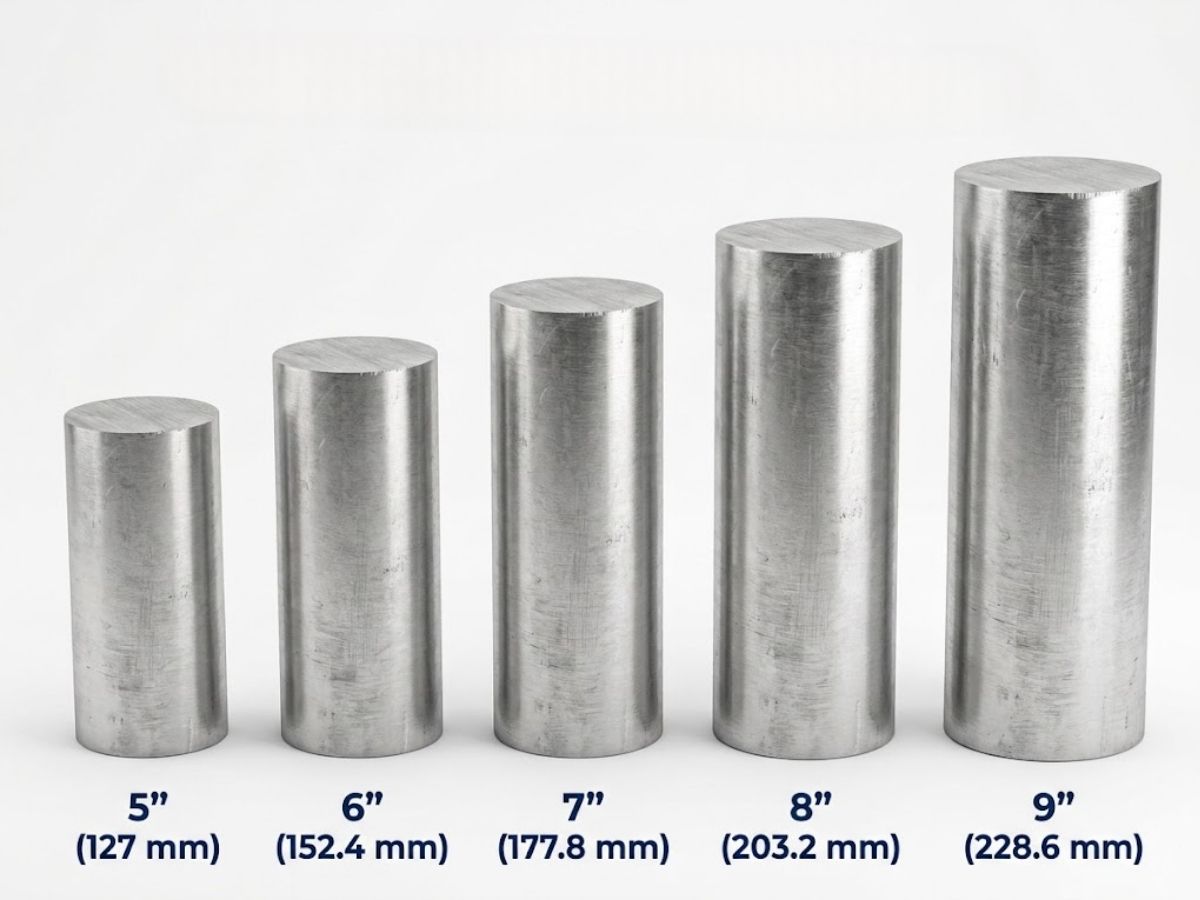
Billet diameters are generally expressed in inches. Their approximate metric equivalents are shown below:
| Billet Diameter | Approx. Diameter | Cross-Sectional Area |
|---|---|---|
| 5" | 127 mm | 126.7 cm² |
| 6" | 152.4 mm | 182.4 cm² |
| 7" | 177.8 mm | 248.2 cm² |
| 8" | 203.2 mm | 324.3 cm² |
| 9" | 228.6 mm | 410.2 cm² |
As billet diameter increases, its cross-sectional area does not increase linearly; it increases with the square of the diameter.
This is an important point.
For example, the diameter of a 10" billet is only twice that of a 5" billet. However, its cross-sectional area is approximately four times greater. Similarly, although the difference between a 6" and an 8" billet may appear relatively small at first glance, the billet cross-sectional area—and therefore the amount of metal available for extrusion—changes significantly.
The Relationship Between Billet Diameter and Cross-Sectional Area
The cross-sectional area of an aluminum billet can be calculated using the following formula:
A = π × r²
Where:
- A = Billet cross-sectional area
- r = Billet radius
- π = Approximately 3.1416
As billet diameter increases, the amount of metal contained within the billet also increases.
For example, when billets of the same length are compared:
- An 8" billet has approximately 78% more cross-sectional area than a 6" billet.
- A 9" billet has approximately 125% more cross-sectional area than a 6" billet.
- A 9" billet has approximately 27% more cross-sectional area than an 8" billet.
Therefore, under suitable press and die conditions, larger-diameter billets can provide significant advantages when producing larger profile cross-sections.
5-Inch Aluminum Billet: For Small and Precision Profiles
5" billets, with a diameter of approximately 127 mm, can be used in smaller-capacity extrusion presses and for relatively small profile cross-sections.
One of the key advantages of this diameter is that its lower metal volume can provide more controlled production for certain applications.
Advantages of 5" Billets
- May be suitable for smaller extrusion presses
- Can be efficiently used for small and lightweight profile cross-sections
- May offer advantages in applications requiring lower extrusion force
- Can facilitate process control in small profile applications
Disadvantages of 5" Billets
- May not provide sufficient metal volume for large profile cross-sections
- Production efficiency may be limited in high-volume applications
- May prevent larger presses from being used at their full container capacity
- May not be suitable for larger cross-sections or multi-cavity dies
5" billets can be considered particularly suitable for small profile cross-sections and extrusion presses equipped with appropriately sized containers.
6-Inch Aluminum Billet: A Common and Versatile Option
A 6" billet, with a diameter of approximately 152.4 mm, is one of the commonly used billet sizes in the aluminum extrusion industry.
6" billets can offer a broad range of applications for small- and medium-sized profile cross-sections. They may be used in architectural systems, window profiles, door profiles, various industrial applications, and general-purpose extrusion production.
Advantages of 6" Billets
- Provides flexibility for a wide range of extrusion applications
- Suitable for small- and medium-sized profile cross-sections
- Can provide high production efficiency when used with suitable presses
- Can accommodate various die and profile geometries
- Provides greater metal volume than a 5" billet
Disadvantages of 6" Billets
- May be insufficient for very large profile cross-sections
- Offers more limited capacity than larger billet diameters when used with high-capacity extrusion presses
6" billets can be a balanced option for extrusion plants serving multiple industries and producing a diverse range of profiles.
7-Inch Aluminum Billet: A Balance Between Medium and Large Cross-Sections
A 7" billet, with a diameter of approximately 177.8 mm, can be considered an intermediate option between 6" and 8" billet diameters.
This diameter can provide advantages in applications where more metal volume is required but the use of an 8" or 9" billet is not necessary.
Advantages of 7" Billets
- Provides greater metal volume than a 6" billet
- May be suitable for medium and relatively large profile cross-sections
- Can provide efficient production when matched with an appropriate press
- Can offer flexibility in production planning for certain profile types
Disadvantages of 7" Billets
- May have a more limited range of standard applications compared with 6" and 8" billets
- Not every extrusion plant has a 7" container or a compatible press
- Compatibility with the plant's equipment must be verified for procurement and production planning
A 7" billet can be a technically optimal solution for a specific press configuration and product range.
8-Inch Aluminum Billet: For Larger Cross-Sections and Higher Capacity
An 8" billet, with a diameter of approximately 203.2 mm, is an important option for larger extrusion presses and applications requiring a higher volume of metal.
Large architectural systems, industrial profiles, structural sections, and larger profile geometries can benefit from the use of 8" billets.
Advantages of 8" Billets
- Provides a high volume of metal
- Enables the production of larger profile cross-sections
- Allows manufacturers to take advantage of larger press capacities
- Can improve production efficiency when combined with appropriate die design
- Can provide higher total profile output in multi-cavity dies
Disadvantages of 8" Billets
- Requires higher press capacity
- Heating and temperature uniformity must be managed more carefully due to the larger diameter
- May not always be the most economical option for small profile cross-sections
- Improper die design and extrusion ratios can lead to production difficulties
8" billets can provide significant production advantages, particularly on higher-tonnage extrusion lines.
9-Inch Aluminum Billet: For Large Presses and High Metal Volume
A 9" billet, with a diameter of approximately 228.6 mm, is used for high-capacity extrusion presses and applications requiring a high volume of metal.
This diameter can be particularly suitable for applications involving large profile cross-sections and high production capacity requirements.
Advantages of 9" Billets
- Provides the highest metal volume among the billet sizes discussed
- May be suitable for large and heavy profile cross-sections
- Allows manufacturers to utilize the capacity of large extrusion presses
- Can provide high production efficiency when combined with appropriate die design
- Can be advantageous for large-scale production operations
Disadvantages of 9" Billets
- Requires a large-diameter container and a high-capacity extrusion press
- Process control can become more critical during billet production and homogenization
- Achieving a suitable extrusion ratio for small profile cross-sections can be more difficult
- Energy and equipment requirements are generally higher
9" billets should be considered for large extrusion plants and applications involving large profile cross-sections.
Comparison of 5", 6", 7", 8" and 9" Billet Diameters
| Feature | 5" | 6" | 7" | 8" | 9" |
|---|---|---|---|---|---|
| Approx. diameter | 127 mm | 152 mm | 178 mm | 203 mm | 229 mm |
| Metal volume | Low | Medium | Medium-high | High | Very high |
| Typical application | Small cross-sections | Small-medium cross-sections | Medium cross-sections | Medium-large cross-sections | Large cross-sections |
| Press requirement | Small | Small-medium | Medium | Medium-large | Large |
| Production capacity | Low | Medium | Medium-high | High | Very high |
| Profile range | Limited | Broad | Medium-high | Broad | Focused on large cross-sections |
| Thermal control requirements | Easier | Moderate | Moderate | High | Very high |
This table provides a general comparison. Under actual production conditions, the suitability of a billet diameter depends on the extrusion press, product design, alloy, die configuration, and other process parameters.
What Factors Should Be Considered When Selecting Aluminum Billet Diameter?
Several technical factors should be evaluated together when selecting the correct billet diameter.
1. Extrusion Press Container Diameter
The first and most important factor is the technical capacity of the extrusion press.
The billet diameter must be compatible with the press container diameter. For example, a press designed for a 6" container cannot directly use an 8" billet.
Therefore, before purchasing or planning billet production, the following specifications should be checked:
- Press capacity
- Container diameter
- Maximum billet length
- Die size
- Maximum extrusion force
Billet diameter selection is not simply a product choice; it is a technical decision directly related to machine capacity.
2. Profile Cross-Sectional Area
The cross-sectional area of the profile is an important factor in determining the required amount of metal.
Larger profile cross-sections generally require greater metal volume. However, producing a large profile does not necessarily mean that a larger billet diameter must always be used.
The relationship between the profile cross-section and billet cross-section should be evaluated through the extrusion ratio.
3. Extrusion Ratio
The extrusion ratio is the ratio of the billet cross-sectional area to the total cross-sectional area of the extruded profile.
The simplified formula is:
Extrusion Ratio = Billet Cross-Sectional Area / Total Profile Cross-Sectional Area
For example:
- Billet cross-sectional area: 324 cm²
- Total profile cross-sectional area: 16.2 cm²
The extrusion ratio would be approximately:
324 / 16.2 = 20:1
The extrusion ratio is one of the fundamental parameters affecting metal flow and process behavior.
However, the optimum extrusion ratio can vary depending on:
- Alloy type
- Profile geometry
- Die design
- Extrusion speed
- Press capacity
- Surface quality requirements
Therefore, it is not technically correct to specify one ideal extrusion ratio for every profile.
4. Aluminum Alloy
The alloy must also be considered when selecting billet diameter.
For example:
- 6060 and 6063 are widely used for architectural and general industrial profiles due to their excellent extrudability.
- 6061 may be used in applications requiring higher mechanical properties.
- 6082 is commonly preferred for industrial and structural applications requiring higher strength.
Each alloy has different hot-deformation behavior. With higher-strength alloys, extrusion force and process conditions can become more critical.
Therefore, billet diameter and alloy selection should be evaluated together.
5. Die Design
The extrusion die cannot be considered independently from billet diameter.
The following die characteristics can affect the extrusion process:
- Number of cavities
- Profile geometry
- Bearing design
- Metal flow balance
- Bridge structure
- Port design
- Die steel and strength
Especially in multi-cavity dies, the total output cross-sectional area increases, meaning that billet diameter and extrusion ratio may need to be recalculated.
6. Billet Length
Billet length is just as important as billet diameter.
Billets with the same diameter but different lengths contain different amounts of metal.
Billet volume can be calculated using the following formula:
V = π × r² × L
Where:
- V = Volume
- r = Billet radius
- L = Billet length
As billet length increases, more profile can be produced per extrusion cycle. However, the maximum billet length is limited by the technical specifications of the press and container.
In addition, butt discard, production planning, and cutting optimization are also affected by billet length.
7. Production Volume and Order Quantity
Billet diameter selection is not only a technical decision; it is also an economic one.
In high-volume production, selecting the appropriate billet diameter can:
- Optimize press cycles
- Reduce die changes
- Lower unit production costs
- Improve production planning
For low-volume orders with a wide variety of profiles, a more flexible billet and press combination may be preferred.
Is a Larger Billet Diameter Always Better?
No.
A larger-diameter billet contains more metal, but this does not necessarily mean it is advantageous for every profile.
For example, extruding a small profile using a very large-diameter billet may result in:
- Unsuitable extrusion ratios
- Unnecessary use of press capacity
- Difficulties in controlling metal flow
- Die and process optimization problems
Likewise, using a billet that is too small for a large profile can reduce production efficiency.
The objective is not to select the largest billet diameter, but the most suitable billet diameter for the specific production requirements.
The Relationship Between Billet Diameter and Extrusion Press Capacity
As extrusion press tonnage increases, the ability to use larger-diameter billets may generally increase as well. However, there is no direct and fixed relationship between press tonnage and billet diameter.
For example, two presses with similar tonnage may still have different:
- Container diameters
- Hydraulic systems
- Maximum operating pressures
- Die dimensions
- Heating systems
Therefore, it is not technically correct to make a general statement such as, "A press with this tonnage must use a billet of this diameter."
The most accurate approach is to evaluate the extrusion press specifications together with the characteristics of the profile being produced.
Billet Diameter and Billet Quality
As billet diameter increases, certain parameters related to production and thermal processing may become more critical to control.
Particular attention should be paid to the following factors, especially for larger-diameter billets:
- Chemical composition uniformity
- Temperature distribution
- Solidification conditions
- Microstructure
- Homogenization
- Surface quality
- Segregation control
Regardless of billet diameter, extrusion performance is not determined by diameter alone. For a high-quality billet, diameter tolerance, chemical composition, microstructure, homogenization, and surface quality are all important.
Practical Checklist for Selecting Billet Diameter
Before selecting the appropriate aluminum billet diameter, the following questions should be answered:
- What is the container diameter of the extrusion press?
- What is the maximum extrusion force of the press?
- What is the cross-sectional area of the profile?
- Will the profile be produced using a single-cavity or multi-cavity die?
- What is the total output cross-sectional area?
- Which aluminum alloy will be used?
- What is the target extrusion speed?
- What billet diameter and press configuration is the die optimized for?
- What is the maximum billet length?
- What is the order quantity and production volume?
- What are the surface quality requirements?
- How will scrap and butt discard be optimized?
When these parameters are evaluated together, a more accurate and economical billet selection can be made.
What Applications Are 5", 6", 7", 8" and 9" Billets Suitable For?
As a general guideline:
5" Billet
Can be considered for smaller extrusion presses and smaller profile cross-sections.
6" Billet
Offers a broad range of applications for small- and medium-sized extrusion profiles and is a versatile option.
7" Billet
Can provide a balance between medium and larger cross-sections and may be optimal for specific press configurations.
8" Billet
Can provide significant advantages for larger presses, higher metal volumes, and larger profile cross-sections.
9" Billet
Provides high metal volume and can be suitable for large-capacity presses and large profile cross-sections.
However, these classifications are general. The final selection should always be validated against actual production parameters.
Frequently Asked Questions
What Is the Main Difference Between 5", 6", 7", 8" and 9" Aluminum Billets?
The main difference is diameter and the resulting cross-sectional area. As diameter increases, the billet cross-sectional area and the amount of metal contained in a billet of the same length also increase.
What Is the Most Common Aluminum Billet Diameter?
The billet diameter used depends on the extrusion plant's press capacity and product range. Diameters such as 6" and 8" are used in a wide range of extrusion applications.
Does a Larger-Diameter Billet Produce More Profile?
A larger-diameter billet of the same length contains more metal. However, total output depends on many factors, including profile cross-section, billet length, scrap, butt discard, and overall process efficiency.
Can an 8" Billet Be Used Instead of a 6" Billet?
This depends on the extrusion press container diameter and technical specifications. An 8" billet cannot be used in a container designed for a 6" billet. The press and die system must be suitable for the larger billet diameter.
Does Billet Diameter Affect Profile Quality?
Indirectly, yes. Billet diameter affects the extrusion ratio, metal flow, press force, and process conditions. Therefore, selecting the appropriate billet diameter can influence the final profile quality.
How Should Billet Diameter Be Selected?
Billet diameter should be selected by considering the press container diameter, profile cross-sectional area, extrusion ratio, alloy, die design, billet length, and production volume together.
Conclusion: How Should the Right Aluminum Billet Diameter Be Selected?
Aluminum billet diameter selection is not simply a matter of choosing a size in the extrusion process. Each of the 5", 6", 7", 8", and 9" billet diameters offers different advantages depending on press capacity, profile cross-section, alloy, and production requirements.
Smaller-diameter billets can offer advantages for certain small and precision profile applications, while larger-diameter billets can provide higher metal volume and greater opportunities for producing large profile cross-sections. However, a larger diameter is not always the better solution.
The correct selection should consider:
- Extrusion press capacity
- Container diameter
- Profile cross-sectional area
- Overall extrusion ratio
- Alloy type
- Die design
- Billet length
- Production volume and efficiency targets
The best results are achieved when billet diameter is optimized as an integrated part of the extrusion press, alloy, die, and profile design.
Biser Aluminum offers a range of aluminum billet diameters and alloy options to meet different extrusion requirements. Billets with diameters ranging from 127 mm to 228 mm can be produced according to customer requirements, extrusion press specifications, and technical production parameters. Aluminum billets in alloys such as 6060, 6061, 6063, and 6082 can be manufactured according to the required chemical composition and quality specifications of the extrusion process.